avday
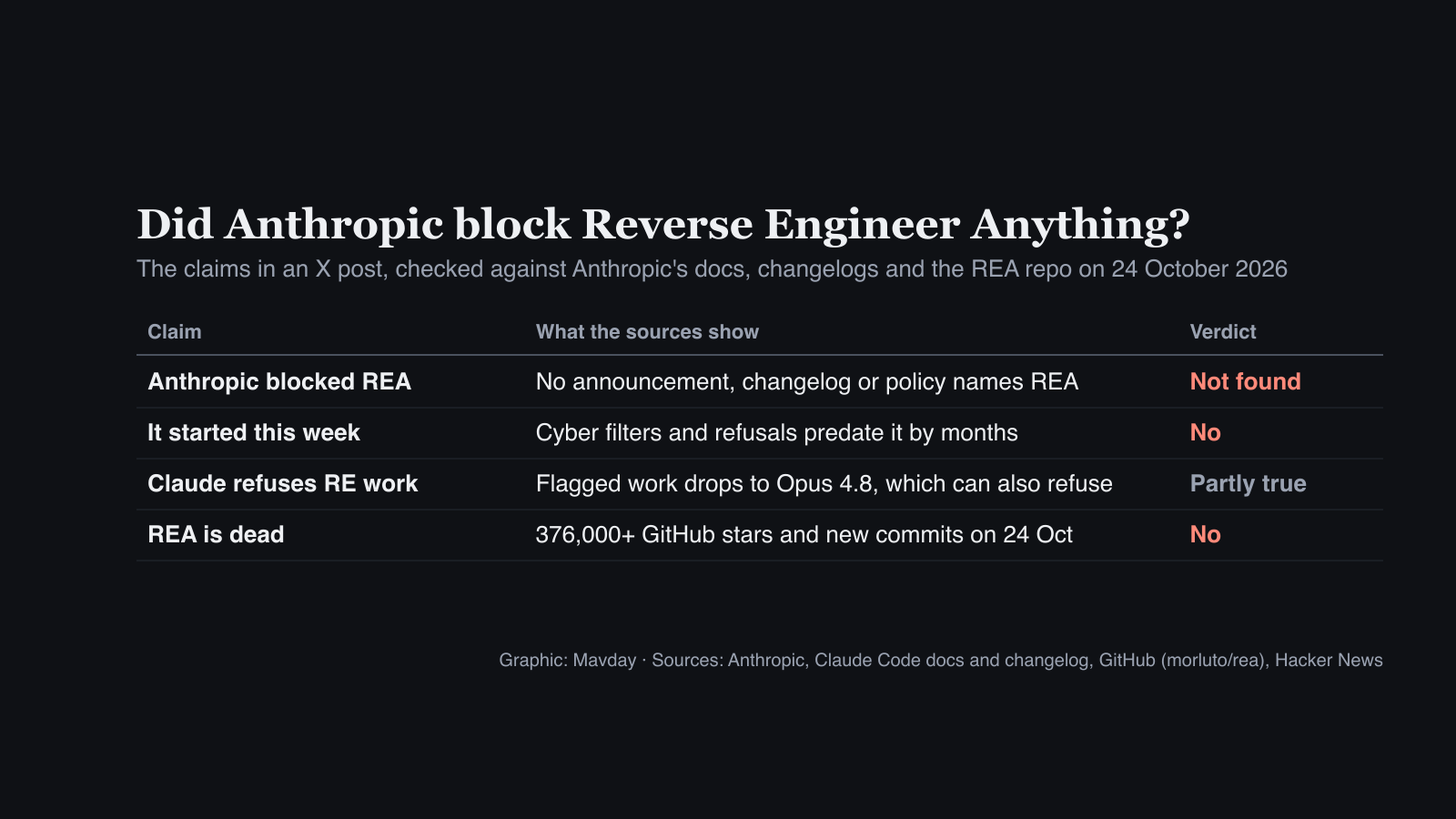
A post on X on 23 October claimed Anthropic had shut Reverse Engineer Anything out of Claude. We found no sign of that. The refusals are real, but Anthropic’s cyber safeguards behind them were in place long before the post.
Reverse Engineer Anything (REA) is the open-source tool that lets coding agents such as Claude Code drive decompilers like Ghidra and IDA. We covered how REA works and the clone wave it started. If you use it, the details below explain the errors you’re seeing and what’s actually allowed.
What Anthropic changed, and when
We found no announcement, Claude Code changelog entry or usage policy change that names REA or reverse-engineering tools. We found no public comment from Anthropic on REA.
What did change is older. Anthropic launched Claude Opus 5.5 on 22 September. It said then that “most cybersecurity tasks will be re-routed to Opus 4.8.” Sonnet 5.5 followed on 28 September, with “higher-risk cybersecurity tasks” falling back to Sonnet 5.
On 6 October Anthropic was blunt about the effect. Its public models, it said, “have conservative cyber safeguards that block most cyber work.”
The Claude Code docs explain how it works. Opus 5.5 and Sonnet 5.5 “run with safety classifiers, which most often flag cybersecurity and biology content.” A flagged request re-runs on the older model. That model has its own safeguards, so it can refuse too.
Reverse Engineer Anything and Claude: the errors you’ll see
When the fallback model also flags a request, Claude Code shows an error like this one, from Anthropic’s docs:
API Error: Opus 4.8's safeguards flagged this message. Our intentionally broad safeguards allow us to deliver more capabilities faster, but can sometimes flag legitimate cybersecurity work. Send feedback with /feedback or learn more: https://support.claude.com/en/articles/14604842-real-time-cyber-safeguards-on-claudeIn their entry on Usage Policy refusals, the docs add a detail that may explain many complaints. “The check evaluates the full conversation, not only your latest prompt, so sending a new message in the same session usually re-triggers the same refusal.”
That matches what users report. In one Claude Code issue on 14 October, a user said that after one flag, the safeguard “started blocking EVERY following message”, including trivial ones. Anthropic’s docs point to starting a new session, or sending feedback with /feedback if you think the flag is wrong.
Is it only REA?
No. The refusals hit reverse engineering in general, and they started before REA went viral.
- July. On Hacker News on 24 July, a developer said they “started reverse engineering a mac app” and were told to switch to Opus 4.8 “because the guardrails kicked in.”
- 10 October. A Hacker News thread about REA already quoted the safeguard message: “Opus 5.5’s safeguards flagged this session.”
- 13 October. A thread in REA’s GitHub discussions asked: “Anyone hitting a wall with Claude on this repo?” One reply: “Everybody hits a wall with Claude on this…”
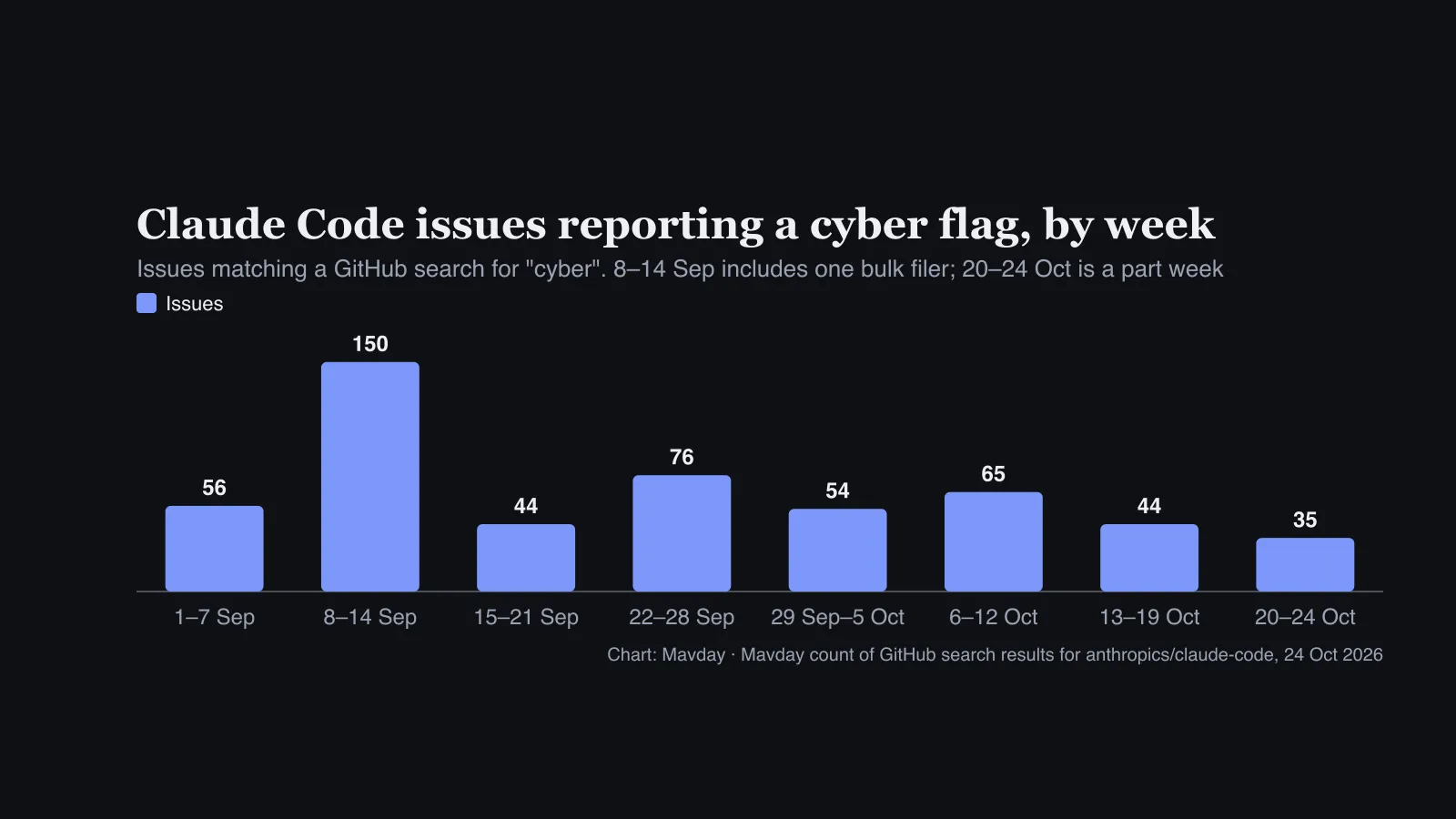
We counted Claude Code GitHub issues that mention “cyber”, week by week since September. The chart above shows no spike around 23 October. It’s a rough measure, because the matches include automated reports and some issues that aren’t flag reports, but it doesn’t support a sudden change.
REA itself is busy. It had more than 376,000 GitHub stars on 24 October, its maintainer was still committing code that day, and the README still lists Claude Code first among supported agents. We found no comment from the maintainer on the claim.
Other agents are a mixed picture. On Hacker News, one user said REA “works fine with Codex 6.1-Sol” after a Claude refusal. Another said their OpenAI account was “permanently banned for doing too much RE work”. In REA’s discussions, a Cursor user said it “always says he can’t do it”.
Where the TV story fits
Part of the buzz comes from people using AI to strip ads and tracking out of smart TVs. 404 Media, Decrypt and XDA covered it between 20 and 21 October. TFTC quoted a widely shared post on X: “Removed all of the samsung spyware from my TV with Codex (Claude refused to root the tv lol).”
The X post on 23 October suggested the TV hacks pushed Anthropic to act. The text we could read gave no source for that, and we found no evidence of it.
What Anthropic allows
Anthropic’s usage policy, in the updated version that takes effect on 12 November, doesn’t mention reverse engineering by name. It bans finding or exploiting vulnerabilities “without authorization of the system owner”, and infringing others’ intellectual property.
It also says the rules don’t prohibit “security research, testing, or tool development conducted on systems you own or operate”. For work its safeguards catch, it points to the Cyber Verification Program. On 6 October Anthropic said that program’s Defense Access covers defensive work, including “reverse-engineering malware”.
Some users in REA’s discussions trade tips for getting past the filters. We’re not repeating them: REA’s own disclaimer rules out “evading the usage policies or safety measures of AI model providers”, and Anthropic’s policy bans bypassing its guardrails.
What happens next
Anthropic’s updated usage policy takes effect on 12 November, and its summary of the changes doesn’t mention reverse engineering. The Opus 5.5 safeguard notice that users have quoted says: “We’re improving these safeguards to reduce the amount of incorrectly flagged messages.”
If an agent can change your code, keep its access tight whichever model it runs on. Our tested Claude Code permissions setup shows how.