avday
OpenAI models are coming to Google Cloud. Google said on 21 October that GPT-6 Astra, GPT-6.1 Sol and GPT-6 Luna are in a private preview for select enterprise customers.
OpenAI says general availability is “planned in the coming weeks.” Until then, OpenAI models on Google Cloud are only for the companies Google lets in.
For developers on Google Cloud, the change is about billing more than access. You can already buy these models from OpenAI, Microsoft and Amazon. On Google Cloud, OpenAI usage will sit on the same invoice as everything else and count against the spend you’ve already committed to Google.
What OpenAI and Google announced
Google’s post, by Michael Gerstenhaber, its vice president of product management for Gemini, lists three models:
- GPT-6 Astra: “Designed for demanding work across coding, computer use, professional tasks, and scientific research.”
- GPT-6.1 Sol: “Near-Astra intelligence at lower cost across agentic coding, computer use, and professional work.”
- GPT-6 Luna: “A fast, cost-efficient model for everyday work at scale.”
They sit in Google Cloud’s Model Garden. Customers in the preview can “build with these models through our APIs and connect their local Codex CLI and Desktop workflows directly to our Gemini platform for inference,” Google said. Both companies say OpenAI models will come to Google Antigravity, Google’s agentic coding tool, soon.
If you’re looking for Vertex AI in all this, it has a new name. Google’s docs now call it the Gemini Enterprise Agent Platform, and Vertex AI Model Garden is now Gemini Enterprise Agent Platform Model Garden.
OpenAI models on Google Cloud: what changes for you
Three things, according to Google’s post:
- One bill. OpenAI models are sold through Google Cloud Marketplace, so “all usage appears on a single Google Cloud invoice, draws down existing cloud commitments, and counts toward Flexible Savings Plans (FSP) across model providers.” If your company has a large Google Cloud commitment, it will be able to spend part of it on GPT-6.
- Data stays in your perimeter. Google says prompts, context and outputs “remain entirely within your designated data perimeter and are never used to train foundation models.”
- Google’s controls. Calls run under an authenticated identity, with VPC Service Controls and unified audit logging.
Some things aren’t there yet. Zero data retention and Confidential Compute are both “coming soon”, in Google’s words. Neither company has published prices for Google Cloud, and there’s no docs page with model IDs, regions or quotas.
When we checked on 22 October, Google’s partner model docs listed Claude, Grok, Mistral and Meta models, but no page for OpenAI’s GPT-6 models. Access is through an interest form, which says filling it in “does not guarantee access.”
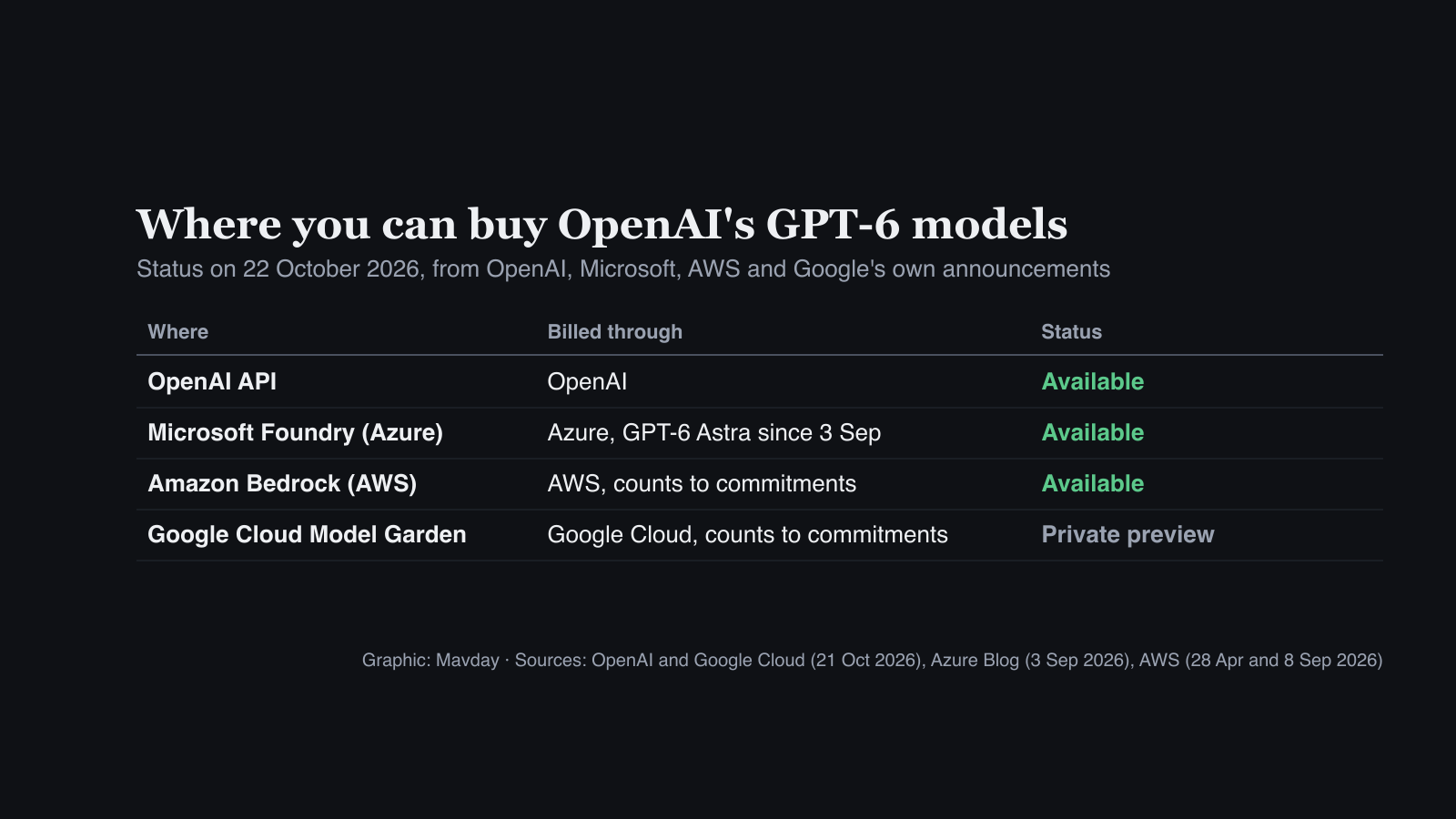
Where you can buy GPT-6 now
| Where | Billed through | Status on 22 Oct |
|---|---|---|
| OpenAI API | OpenAI | Available |
| Microsoft Foundry (Azure) | Azure | GPT-6 Astra generally available since 3 Sep |
| Amazon Bedrock (AWS) | AWS, counts towards AWS commitments | GPT-6 Astra generally available since 8 Sep |
| Google Cloud Model Garden | Google Cloud, counts towards GCP commitments | Private preview, select enterprises |
AWS said when OpenAI models became generally available on Bedrock in June that “Pricing matches OpenAI first-party rates.” Google hasn’t said whether it will do the same.
Google now claims to be “the only hyperscale cloud provider offering access to all three leading closed source LLMs”. It doesn’t name them, but its catalogue has Gemini, Claude and now GPT. Anthropic’s Claude models have been on Google Cloud since 2024.
Why OpenAI can do this now
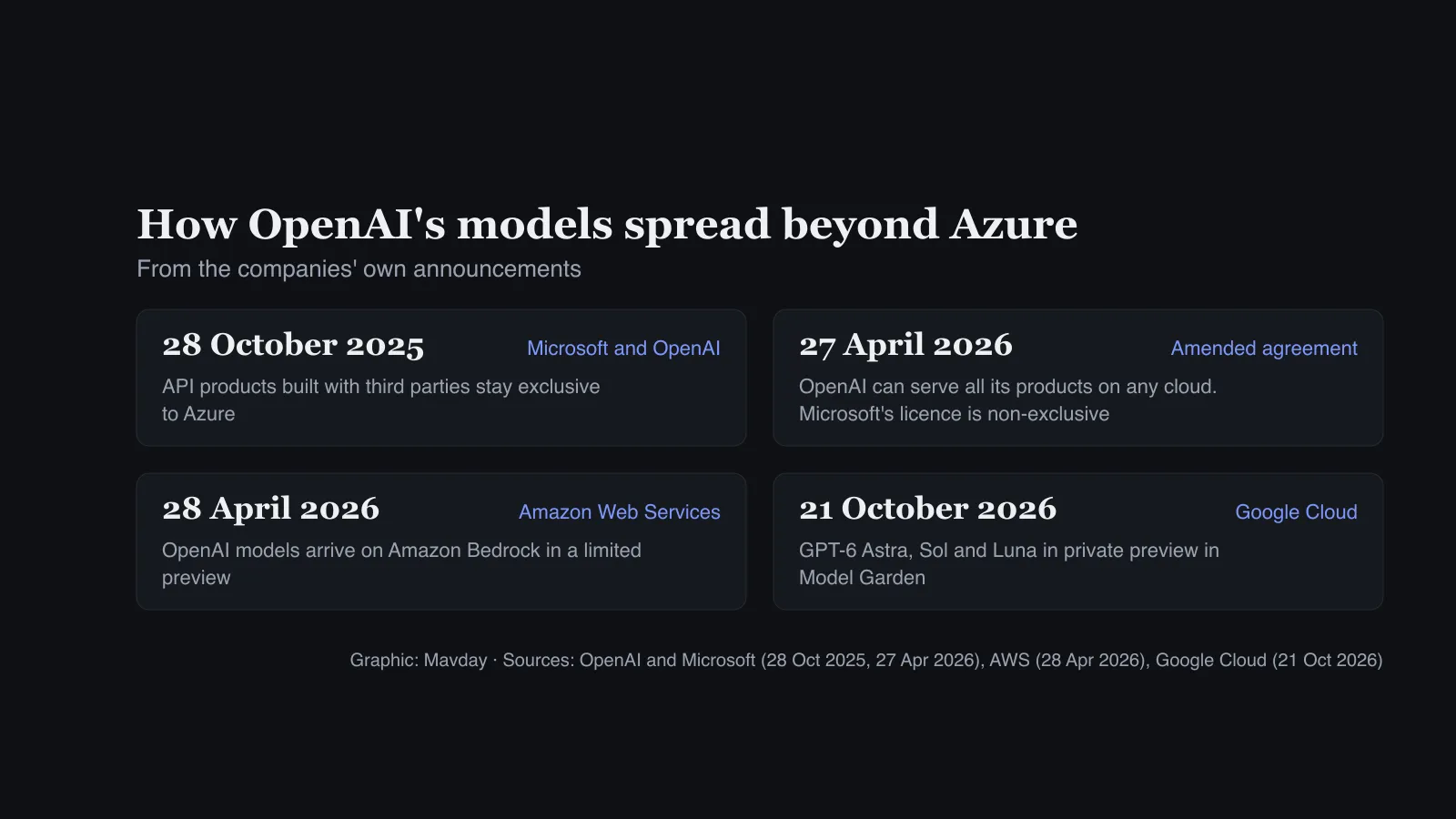
Until April, Microsoft had the sole right to host OpenAI’s API. The two companies’ October 2025 agreement said “API products developed with third parties will be exclusive to Azure.”
That changed on 27 April 2026. Under the amended deal, “OpenAI can now serve all its products to customers across any cloud provider,” and Microsoft’s licence became non-exclusive. OpenAI’s models reached Amazon Bedrock in a limited preview the next day. Google Cloud is the latest to get them.
Microsoft still has a head start. The April agreement says OpenAI products “will ship first on Azure, unless Microsoft cannot and chooses not to support the necessary capabilities.” OpenAI’s announcement ends: “Microsoft remains OpenAI’s primary cloud partner.” We found no public statement from Microsoft about the Google deal.
For background, see our coverage of OpenAI’s $30bn funding round, and of Microsoft pulling out of a UK data centre it had planned with Nscale.
What happens next
OpenAI says general availability is “planned in the coming weeks”, without a date. Watch for three things when it arrives: per-token prices, the regions it runs in, and whether zero data retention is ready. Alphabet, Microsoft and Amazon all report quarterly results in the week starting 26 October, CNBC reported.