avday
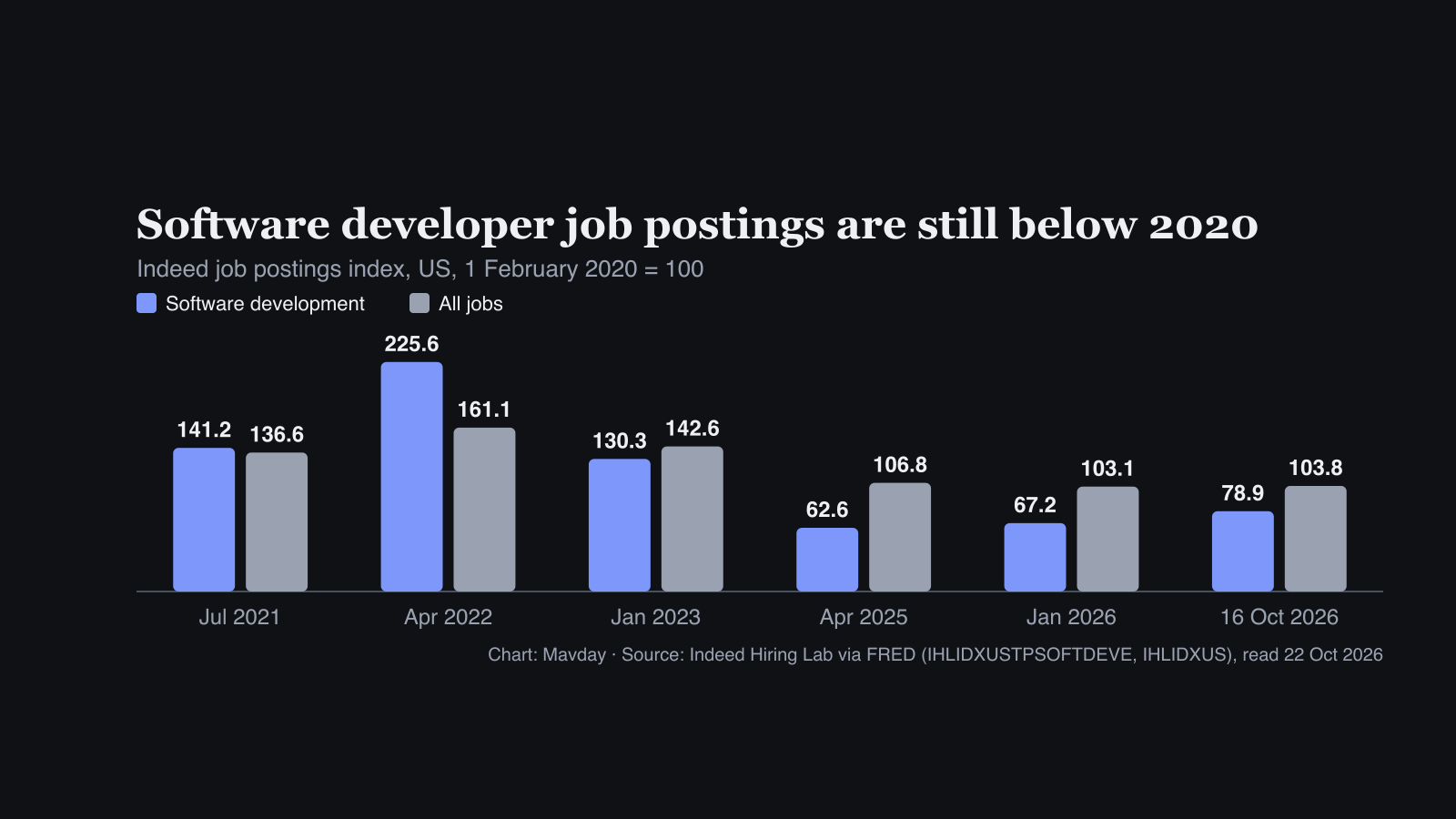
US job postings for software developers were 21% below their February 2020 level on 16 October, while postings for all jobs were 4% above it.
So the data doesn’t show developers being replaced across the board. It does show the first job getting much harder to land.
Here’s what the hiring and productivity data say, and how they compare with what tech bosses predicted.
Is AI replacing software developers? The short answer
Not overall. The US Bureau of Labor Statistics counted 2.25 million people working as software developers in 2025, up from 2.09 million in 2022. Its latest projection, from August, has the job growing 10% between 2025 and 2035.
The damage is narrower. Fewer jobs are being advertised, far fewer of them are for beginners, and older job titles are shrinking. “Computer programmer” employment fell from 457,000 to 381,000 over the same three years. The BLS expects it to decline another 7% by 2035.
What job postings show
Indeed’s index of US software development postings peaked at 233.8 in February 2022, during the hiring boom, and bottomed out at 61.1 in May 2025. On 16 October it stood at 78.9. Indeed’s index for all jobs was 103.8.
The fall started well before the first coding agents. Postings had already dropped from their peak to 142.5 by the day ChatGPT launched, in November 2022.
The recent recovery has a clear shape. Indeed’s Hiring Lab wrote in July that postings had “grown by almost 15% since the launch of Claude Code in late February, 2025”. It found that “71% of the increase” between May 2025 and May 2026 “is from senior roles”, and that 37% came from jobs with AI in their title.
Where the squeeze is: the first job
The clearest signal is at the start of careers. In the first quarter of 2026, just 4.5% of software development postings on Indeed were entry-level, the lowest of any sector in its comparison. Senior roles made up 69.3%.
Stanford’s Digital Economy Lab tracks payroll records from ADP, the payroll company. Its August 2026 revision looks at workers aged 22 to 25 in the most AI-exposed jobs. Their employment was 19% below where it would be had it kept pace with less-exposed peers. It found no comparable gap for experienced workers.
The authors are careful about the cause. A February note found that, once other factors are controlled for, the link with AI exposure “starts in 2024, not late 2022 or 2023”. It found little support for interest rates as the explanation, but said AI isn’t the only factor. The paper adds: “We find no evidence of widespread, economy-wide job displacement.”
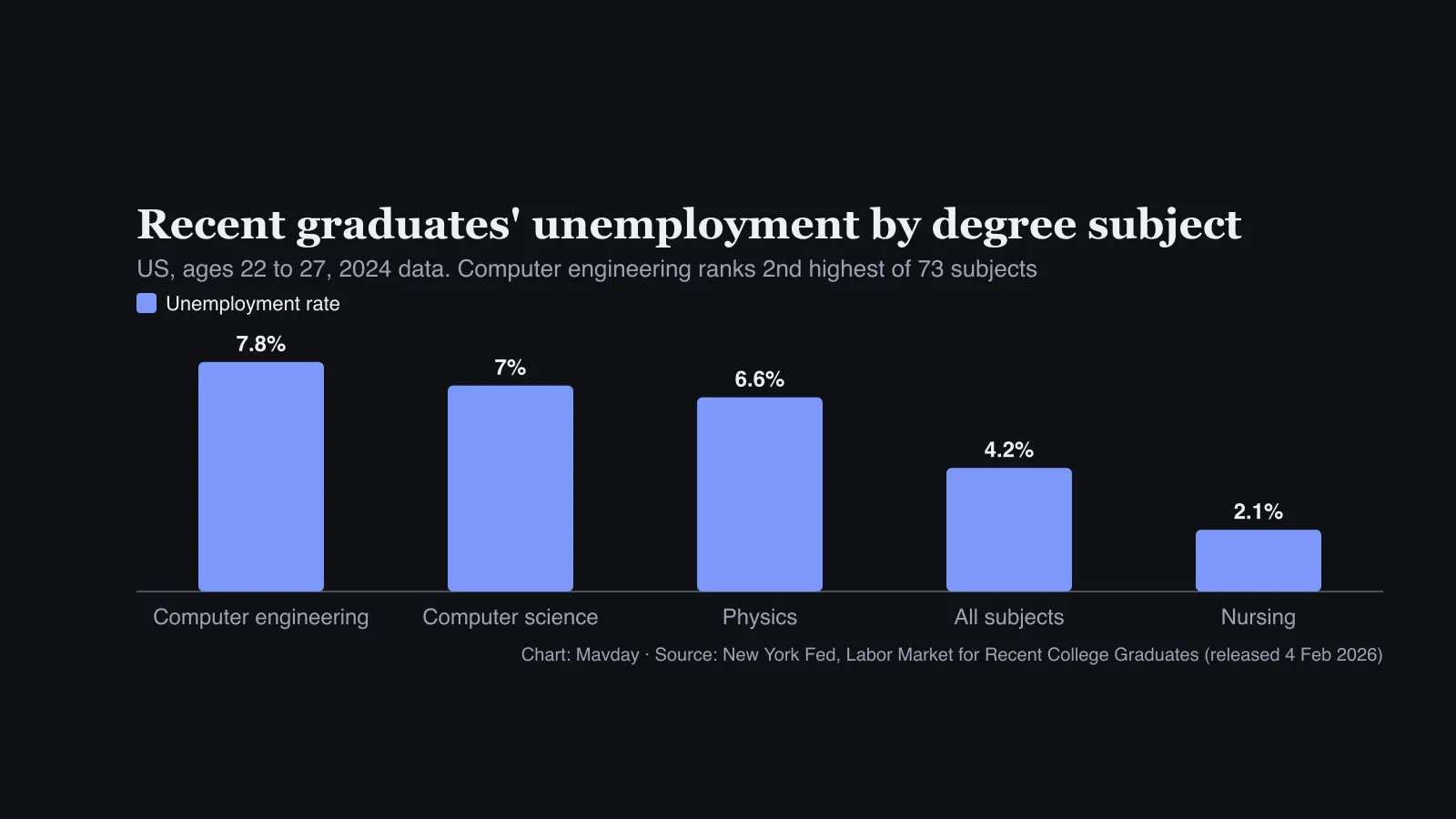
New graduates feel it. In New York Fed data for 2024, computer engineering had the second-highest unemployment of 73 degree subjects among 22 to 27-year-olds, at 7.8%. Computer science was 7.0%, against 4.2% for all graduates.
Does AI make developers faster?
It depends who you measure, and how.
- Google ran a trial with 96 of its own engineers in 2024. Its best estimate of the speed-up was “about 21%”, with a wide margin of error.
- Microsoft, Accenture and a Fortune 100 company ran field trials with 4,867 developers. Pooled by economists, they showed 26% more completed tasks. Less experienced developers gained most.
- METR, an AI research group, ran a randomised trial in early 2025 with experienced open-source developers. They expected AI to speed them up by 24%, but “they take 19% longer to complete issues”.
METR started a new study with newer tools in August 2025. In February 2026 it called the data “an unreliable signal”, partly because developers “do not wish to work without AI”. It said the true effect is likely larger than it measured.
Quality is the other half. In March, METR reported that “roughly half of test-passing SWE-bench Verified PRs” written by AI would not have been merged by the projects’ maintainers. Google’s 2025 DORA report found 30% of developers have “little or no trust” in AI-generated code.
What ten months with a coding agent looked like at Microsoft
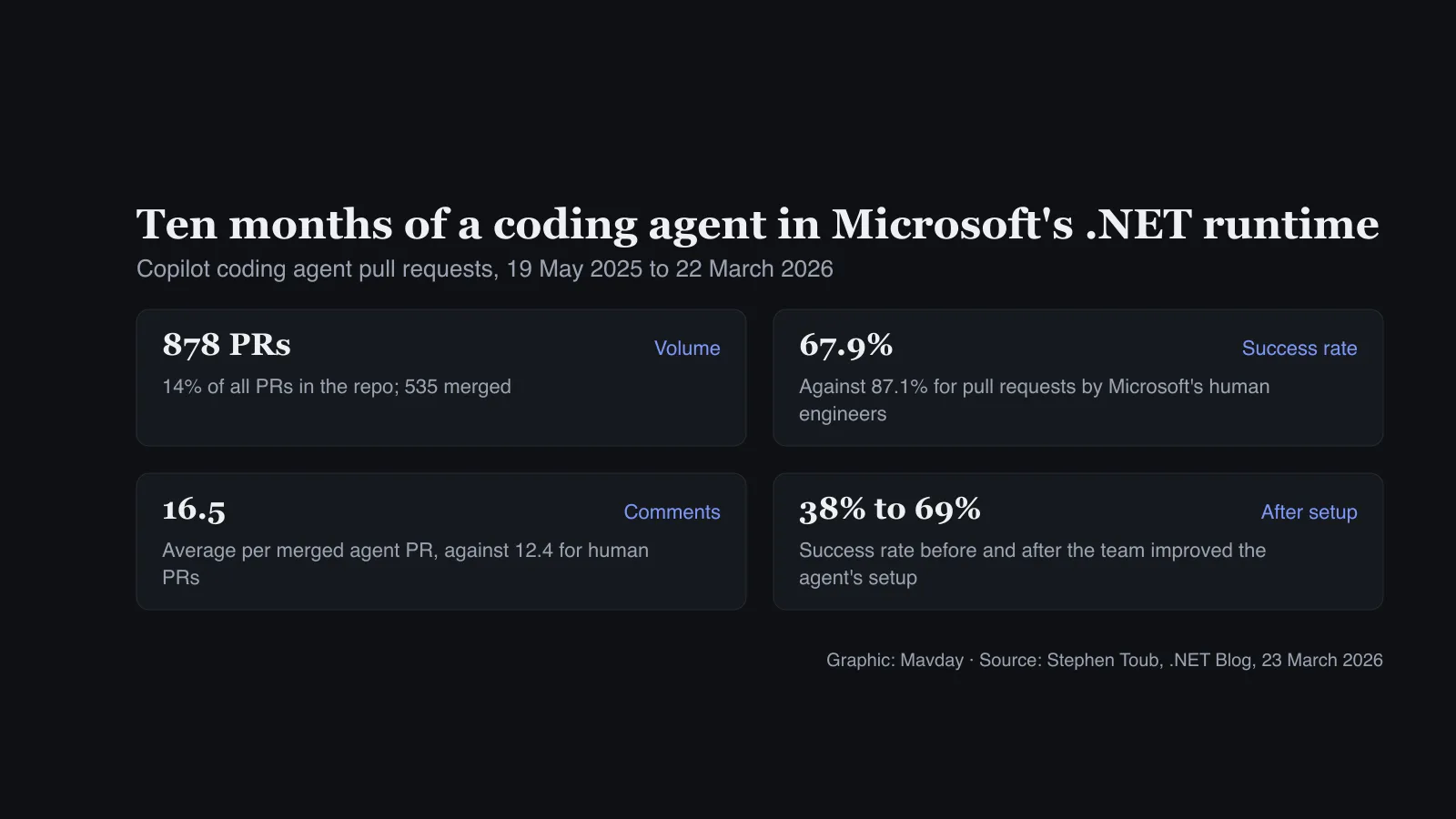
One detailed public case study comes from Microsoft’s .NET team. Stephen Toub, a Distinguished Engineer, published ten months of data on its Copilot coding agent in the dotnet/runtime repository in March.
The agent opened 878 pull requests, 14% of all those in the repo. Its success rate was 67.9%, against 87.1% for pull requests from Microsoft’s own engineers. Its merged changes drew more comments: 16.5 on average, against 12.4 for human pull requests.
Two of Toub’s findings stand out. The agent’s success rate rose from 38.1% to 69% once the team improved its setup: “preparation matters more than the model.” And review became the limit: “The bottleneck has moved.” His conclusion: “CCA is a force multiplier, not a replacement.”
What the bosses said
| Who | What they said | When | What the data shows |
|---|---|---|---|
| Dario Amodei, Anthropic | In three to six months, “AI is writing 90 percent of the code” | 10 March 2025 | Developer postings grew almost 15% after Claude Code launched |
| Marc Benioff, Salesforce | “We’re not going to hire any new engineers this year” | 26 February 2025 | Salesforce’s engineering headcount stayed at about 15,000, Fortune reported in May 2026 |
| Sundar Pichai, Google | “75% of all new code at Google is now AI-generated and approved by engineers” | 22 April 2026 | Controlled trials have found gains of about 21% to 26% |
The claims and the measurements aren’t contradictory: AI can write most of the lines while people still review and ship them. But “writes the code” and “replaces the developer” turn out to be different things.
What it means if you write software

Employers are hiring experience. Seven in ten developer postings are senior. In Microsoft’s audit, review became the bottleneck, and better preparation lifted the agent’s success rate.
AI skills are now part of the job. More than a third of the posting recovery came from roles with AI in the title. In Stack Overflow’s 2026 survey, 80% of daily AI users said they used it for at least an hour a day.
If you’re starting out, you’re competing for fewer seats. Expect it to take longer. Treat real contributions as your strongest signal: shipped projects, merged open-source pull requests, internships.
For how experienced engineers actually work with these tools, see how leading developers code with AI agents. For what can go wrong when agents work unsupervised, see how two OpenAI coding agents weakened misalignment monitoring.
Our take
The loudest claims measure the wrong thing. “Percent of code written by AI” counts lines. The numbers that decide jobs are postings, payrolls and changes that actually ship, and those move far less.
The clearest signal in the data is review. Microsoft’s agent drew more comments per change than its engineers did. METR found half of test-passing AI fixes wouldn’t be merged. DORA links AI adoption to less stable delivery. The scarce skill is checking AI’s work quickly and well.
The early-career squeeze is real, but its cause isn’t settled. Stanford’s own authors say AI isn’t the only factor. Anyone who tells you exactly how much of it is down to AI is guessing.