avday
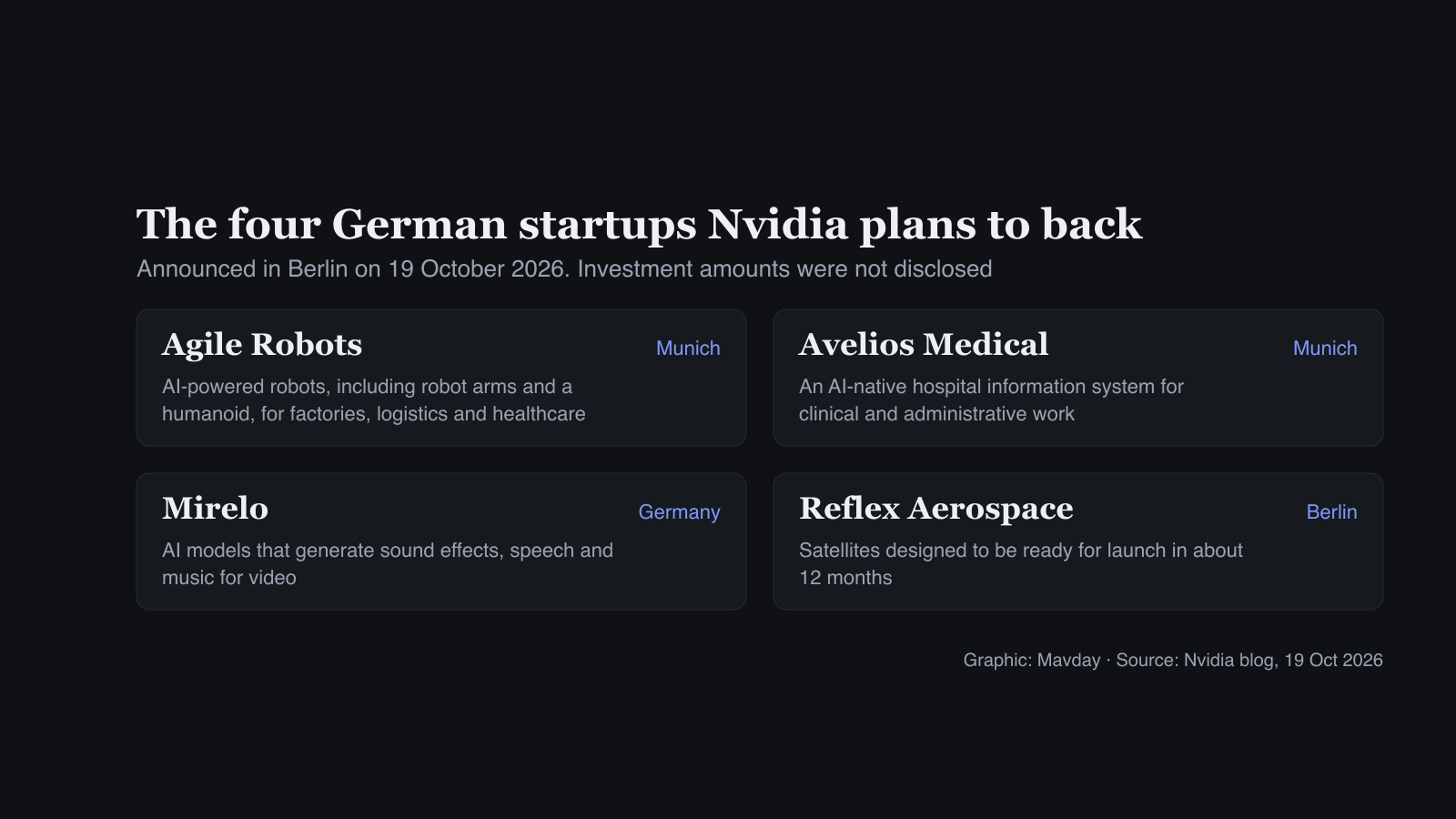
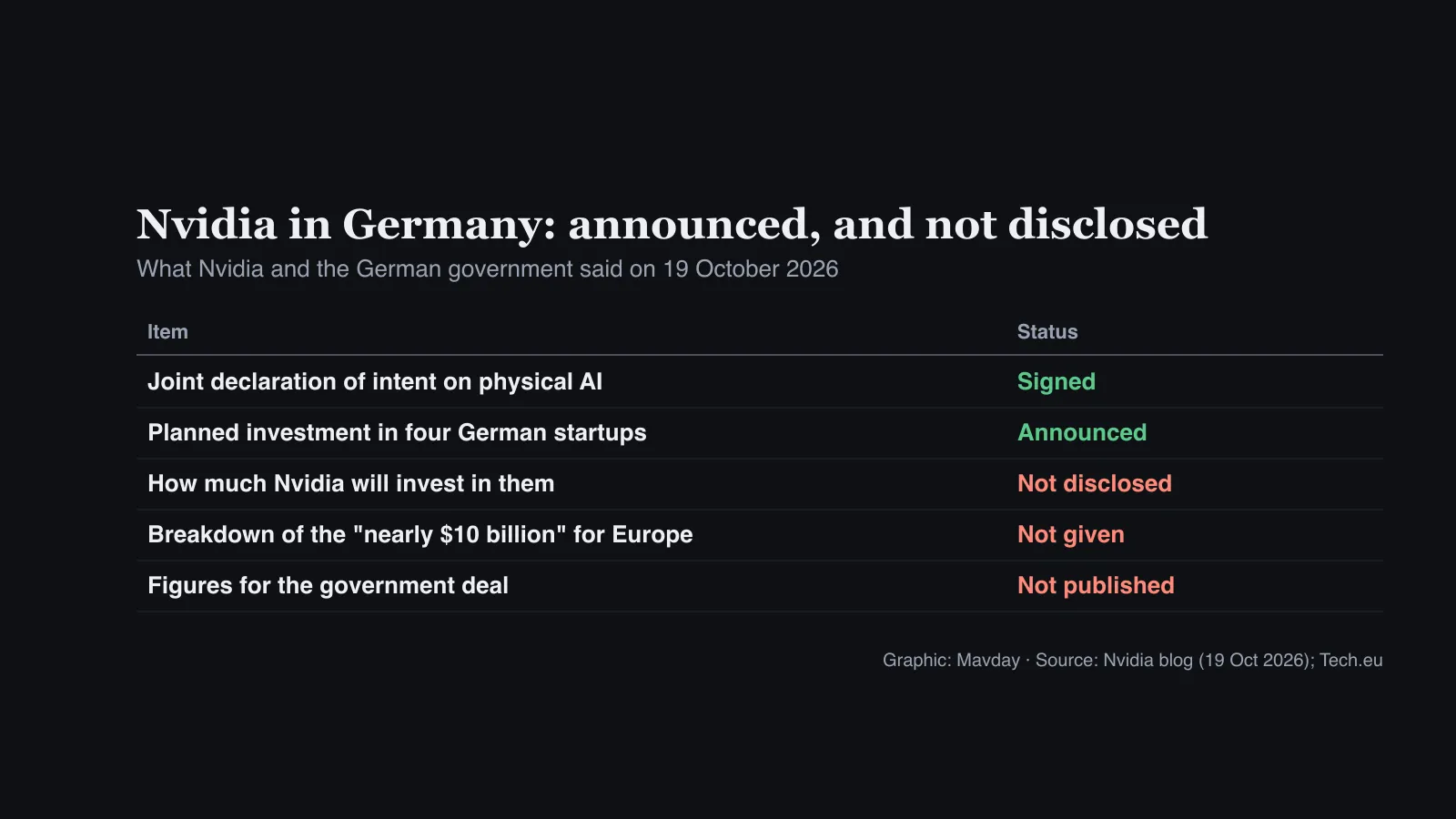
Nvidia signed an industrial AI agreement with the German government on 19 October and named four German startups it plans to invest in. It didn’t say how much.
Chief executive Jensen Huang made the announcements in Berlin at the Invest in Germany Summit, held in Kraftwerk, a former power station. Chancellor Friedrich Merz was there for the signing.
What Nvidia and Germany agreed
The deal is a joint declaration of intent, signed by Merz, the Federal Ministry for Economic Affairs and Energy and the Federal Ministry for Research, Technology and Space. It commits them to a joint initiative with Nvidia on AI models for “physical AI”: AI that controls robots, machines and factories rather than writing text.
According to Nvidia, it also expands the company’s existing work with the government’s Industry 4.0 platform. A declaration of intent isn’t a contract, and neither side published figures for it.
The four startups Nvidia is backing
| Startup | Base | What it does |
|---|---|---|
| Agile Robots | Munich | AI-powered robots, including robot arms and a humanoid, for factories, logistics and healthcare |
| Avelios Medical | Munich | An AI-native hospital information system |
| Mirelo | Germany | AI models that generate sound effects, speech and music for video |
| Reflex Aerospace | Berlin | Satellites built to be ready for launch in about 12 months |
Nvidia calls these planned investments and hasn’t disclosed the amounts. They sit inside what it describes as a “nearly $10 billion” commitment to companies, universities and research institutions across Europe. Nvidia gave no breakdown of that figure. Tech.eu notes that Nvidia already backs two other German startups, n8n and Black Forest Labs.
Siemens and the factory numbers
Siemens announced a partnership with Nvidia on autonomous factories and showed AI tools at its Erlangen plant. The claims, as Nvidia reported them: running a production ramp-up fully in simulation cut engineering effort by up to 85%, and agent-based production planning saved up to 20% on costs.
Those are the companies’ own figures, and “up to” means best case. Tech.eu also reported deals with other German partners, including Mercedes-Benz.
What Merz and Huang said
Merz pitched Germany’s mid-sized manufacturers, the Mittelstand, as its edge. “The biggest advantage we have in Germany is our so-called Mittelstand,” he said, according to Nvidia’s account of the event. CNBC reported that he urged businesses to “open your doors for AI” and make use of their data.
Huang played down job fears: “AI can only augment your capability, it will not replace your capability.”
Why it matters
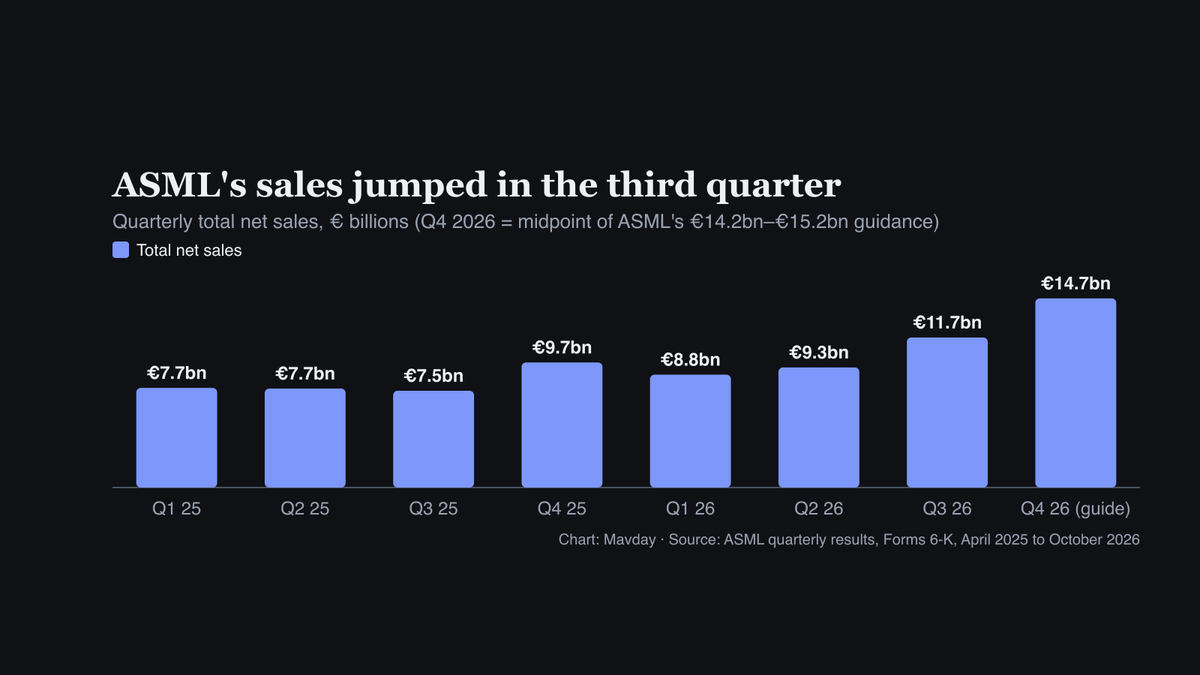
The pitch is that Germany’s factories hold the data that physical AI needs, and Nvidia sells the chips and software to train on it. That demand runs back down the supply chain, to TSMC, which makes Nvidia’s chips, and to ASML, which makes the machines TSMC needs.
For European builders, the signal is that robotics, industrial software and sovereign AI are where Nvidia is putting money in Europe, not only in chatbots.
What happens next
Huang gives the GTC Berlin keynote on 21 October. The two things to watch for are a breakdown of the “nearly $10 billion”, and any detail on the computing capacity behind the government deal.