avday
On the evening of 13 October, Cipher Digital priced $850m of convertible notes that pay no interest. The next day, CoreWeave’s bonds sold off, and with them the shares of almost every company building AI data centres. Cipher closed 12.3% lower on Nasdaq on 14 October, at $9.94. PitchBook wrote that “Data center bonds scraped fresh lows this week as data center developer Cipher Digital’s new debt raise fueled investor anxiety over AI overspending.”
Cipher, the former Cipher Mining, is one of several companies, along with IREN, that have turned bitcoin mining sites into AI data centres, or built new ones. They all have the same problem: data centres cost billions to build before the first rent arrives. How they pay for them matters more after the CoreWeave sell-off, because it showed how quickly lenders can change their minds.
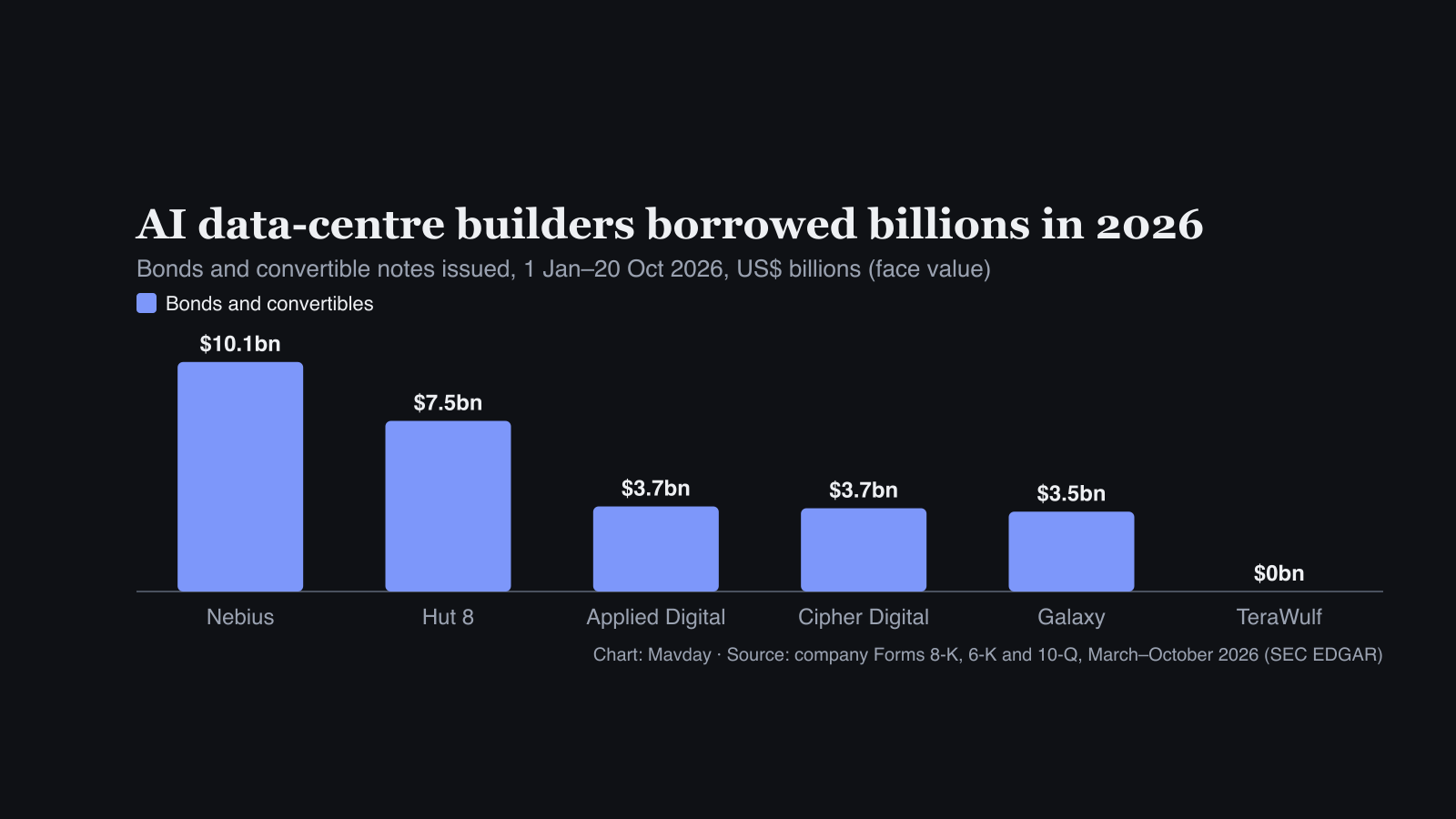
We read the filings of six of these companies. Between 1 January and 20 October 2026, they issued more than $28bn of bonds and convertible notes between them (our total from their filings; see the chart above). Three of them show three very different approaches.
The share prices
Nasdaq closing prices.
| 13 Oct | 14 Oct | 15 Oct | 16 Oct | 13–16 Oct | |
|---|---|---|---|---|---|
| Nebius (NBIS) | $206.86 | $186.01 | $188.41 | $165.47 | −20.0% |
| Cipher Digital (CIFR) | $11.34 | $9.94 | $10.04 | $8.98 | −20.8% |
| TeraWulf (WULF) | $13.21 | $11.54 | $12.62 | $11.68 | −11.6% |
| CoreWeave (CRWV) | $77.81 | $65.78 | $69.69 | $61.39 | −21.1% |
Cipher’s fall on 14 October is not a clean read on the CoreWeave effect. New convertible notes often push a share price down on their own, because buyers of the notes hedge by selling the stock.
Nebius: low-interest convertible notes and new shares
Nebius, based in Amsterdam, raised most of its money this year through convertible notes, which can turn into shares if the share price rises enough.
- March 2026: $4.34bn of convertibles due 2031 and 2033, at 1.25% and 2.625%.
- August 2026: $5.75bn in two series. The 2030 notes pay 0.50% and convert at about $313.46 a share, a 40% premium to the price at the time. The 2034 notes pay 4.50% and convert at about $324.65.
- July 2026: its “first secured debt financing”, $775m at SOFR plus 2.50%, backed by GPUs already in use and an investment-grade customer contract, according to its Q2 shareholder letter.
- It also sold about $2.8bn of new shares through 30 June.
Nebius’s customers include Meta, which signed an agreement in March worth “up to approximately $27 billion”, and Microsoft. Gil Luria of DA Davidson told CNBC on 15 October: “Look at a comparable company like Nebius… They literally sell the same thing to the same companies and have almost no financial leverage.”
Convertible notes are still debt until they convert, and Nebius now has more than $10bn of them. They are cheap in cash terms, but they cost existing shareholders if they turn into new shares. And if the shares don’t rise enough, the notes have to be repaid in cash. Nebius’s 2030 notes must be repaid at 110% of their face value.
Cipher: project bonds backed by big tenants
Cipher builds data centres and leases them to large tenants. It borrows mostly at the level of each project, secured on that project’s lease:
- $2.0bn of 6.125% senior secured notes for its Black Pearl site, issued in February. The tenant is AWS, on a 15-year lease.
- $810m of 6.000% senior secured notes for its Stingray site, in June, also leased to AWS.
- $850m of 0% convertible notes due 2032, in October. They convert at about $15.31 a share, a 35% premium to the $11.34 close on 13 October.
Cipher had $6.0bn of total debt at 30 June. Its biggest project, Barber Lake in Texas, is leased to Fluidstack, a smaller AI cloud company. Google has agreed to “backstop certain obligations of Fluidstack” under that lease, Cipher’s 10-Q says. In return, Cipher gave Google warrants for 24.2 million shares. The 10-Q also warns that the backstops “will only be effective after rent commencement” and are “subject to certain limitations”.
Cipher’s investor presentation from 13 October shows why it needed more money. The estimated cost of Barber Lake has risen to about $2.94bn–$2.97bn, against an original budget of $2.157bn. In September Cipher signed a second 10-year lease at the site with an unnamed “leading AI lab”, adding about $5.2bn of contracted revenue.
Wells Fargo analysts kept their Overweight rating after the deal, but wrote, as quoted by Blockspace: “Zero coupon makes the cash cost appear negligible, but in reality is equity sold forward on a stock that’s down -30% in the past week.”
TeraWulf: no new debt this autumn
TeraWulf announced no new bond, convertible or share sale between August and October, according to its SEC filings and press releases. It raised money earlier in the year instead:
- April 2026: it sold 54.5 million new shares at $19.00, raising $1.04bn before costs, to build its Hawesville site in Kentucky.
- July 2026: it sold its 50.1% stake in the Abernathy joint venture for about $530m in cash, paid in stages to April 2027.
- It still carries $3.2bn of 7.75% senior secured notes due 2030, issued in October 2025, plus three series of convertible notes.
TeraWulf’s tenants include Fluidstack, with a Google backstop, at its Lake Mariner site in New York, and Anthropic, which signed a 20-year lease worth about $19bn at Hawesville. Its chief financial officer, Patrick Fleury, said in August: “The delivery of CB-3 also unlocked $600 million of Google’s credit support for Fluidstack’s lease obligations.”
What the filings show across the group
One pattern stands out. The cheapest money goes to projects with the strongest tenants. Cipher’s AWS-backed project bonds pay about 6%. CoreWeave issued its 2031 notes at 9.75%, and they traded at yields near 16% last week. On these figures, what lenders charge seems to depend less on the data centre itself than on who pays the rent, and whether a company such as Google stands behind the tenant.
That also links these companies to CoreWeave in a less obvious way. CoreWeave is a tenant as well as a borrower. Galaxy’s $3.5bn bond, issued in July, funds a data centre leased to CoreWeave, and Applied Digital’s Polaris Forge 1 campus is also leased to CoreWeave, according to their filings. As Paul Meeks of Freedom Capital Markets told CNBC: “Sometimes the AI colos are actually landlords of the neoclouds”.
What to watch
- TeraWulf reports third-quarter results on 6 November. Cipher and Nebius haven’t announced their dates.
- Whether Cipher’s banks take up the option to buy another $150m of notes. The option runs for 13 days.
- Rent start dates. Google’s backstops at Cipher and TeraWulf only apply once rent starts, so delivery dates matter.
Our take
FAQ
What did Cipher Digital announce in October 2026? Cipher priced $850m of 0% convertible senior notes due 2032 on 13 October, with a conversion price of about $15.31 a share. It plans to use the money for its Barber Lake project, its wider data-centre pipeline and general purposes.
Is Cipher Mining the same company as Cipher Digital? Yes. Cipher Mining changed its name to Cipher Digital in February 2026. It still trades on Nasdaq as CIFR.
How much debt do Nebius, Cipher and TeraWulf have? Cipher reported $6.0bn of total debt at 30 June 2026. Nebius has issued more than $10bn of convertible notes in 2026. TeraWulf has $3.2bn of senior secured notes plus convertible notes, and raised equity rather than debt in 2026.
Why did Nebius stock fall in October 2026? Nebius fell 20.0% on Nasdaq between 13 and 16 October, alongside CoreWeave and other AI cloud and data-centre stocks, as a sell-off in CoreWeave’s bonds and a Gartner forecast on neoclouds hit the whole group. Nebius made no announcement that explains the move.