avday
CoreWeave shares closed at $61.12 on Nasdaq on 19 October, down 33.4% from $91.72 on 6 October. The worst day was 14 October, when the stock fell 15.5% to $65.78 as investors sold CoreWeave’s bonds as well as its shares.
CoreWeave is the largest of the “neoclouds”, companies that rent GPU capacity to AI labs and big tech firms. It funds that business mostly with borrowed money. For two years investors cared mainly about how fast its contracts grew. This month, the bond market started asking a different question: what happens if the cost of all that borrowing keeps rising? The company’s own filings answer part of that question, and they are worth reading closely.
What happened, day by day
All share prices are Nasdaq closing prices.
| Date | Close | What happened |
|---|---|---|
| 6 Oct | $91.72 | Starting point |
| 13 Oct | $77.81 | Down 3.1% |
| 14 Oct | $65.78 | Down 15.5%: bond sell-off, Gartner neocloud forecast |
| 15 Oct | $69.69 | Up 5.9% after an early fall |
| 16 Oct | $61.39 | Down 11.9% |
| 19 Oct | $61.12 | Down 0.4%; Goldman Sachs upgrade |
The bonds (14–16 October)
CNBC first reported the sell-off on 14 October. The bonds at the centre of it are CoreWeave’s $2.75bn of 9.75% senior notes due 2031, which it issued in April 2026. PitchBook, writing on Morningstar, reported that they traded as low as 78 cents on the dollar on 14 October, a yield of 16.39%, and recovered to 83 the next day. CoreWeave’s 9.625% notes due 2032 fell to 75 before recovering to 80.
Insurance against a CoreWeave default got more expensive too. Reuters reported on 15 October that the cost of five-year credit default swaps had passed 1,000 basis points. By Reuters’ calculation, that implied a chance of default within five years of nearly 63%, compared with about 30% a year earlier. That figure is a market-implied estimate, not a rating. CNBC gives CoreWeave’s S&P issuer rating as B+, and we found no rating action from Moody’s, S&P or Fitch this month.
Gartner (14 October)
On the same day, Gartner published a forecast on AI infrastructure. As quoted by CNBC, it said: “By 2030, Gartner predicts that cost pressure and a lack of a differentiating business model will force over 80% of neocloud providers to cease independent operations.” Gartner analyst Will Sommer told Reuters that “enterprise and consumer AI revenue will be insufficient to support profitable returns on all planned AI capital expenditures during this period.” Gartner named no companies. On 19 October its analyst John Lovelock told CNBC that the forecast means consolidation, such as takeovers and mergers, rather than mass failure.
The sell-off also hit IREN, which fell 34.6% in ten days, and other neoclouds such as Nebius.
What CoreWeave has said
CoreWeave has issued no press release or 8-K filing about the sell-off. Its most recent announcement, on 7 October, was a data-centre partnership in India.
Chief executive Mike Intrator wrote to staff in an internal memo, which CNBC obtained on 14 October: “When you are building a new type of technology company there will be periods of time when the market misunderstands and acts irrationally.” He added: “We are confident in our backlog which more than supports all of our debt obligations.”
What the filings show
CoreWeave’s latest full numbers are for the quarter to 30 June 2026, in its 10-Q filed on 12 August.
| Quarter to 30 June 2026 | Figure |
|---|---|
| Revenue | $2,575m |
| Net interest expense | $640m |
| Net loss | $(626)m |
| Cash spent on property and equipment | $6,422m |
| Cash and equivalents | $5,524m |
| Debt (principal outstanding) | $35,551m |
| Operating lease liabilities | $16,319m |
| Remaining performance obligations (contracted future revenue) | $103.7bn |
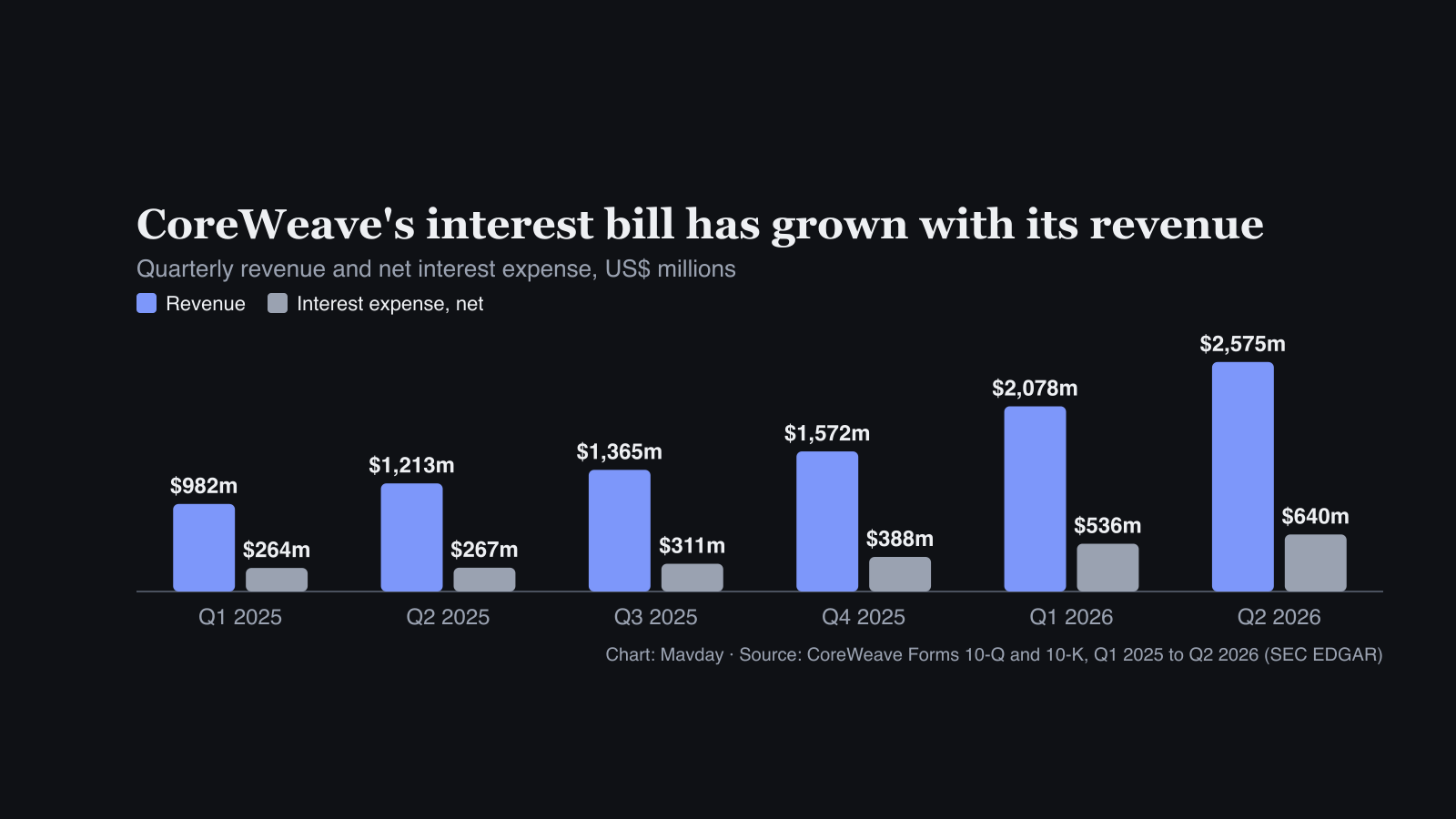
The chart at the top of this article shows the main pattern. CoreWeave’s revenue has grown about 2.6 times in five quarters. Its net interest bill has grown about 2.4 times, and it has stayed at between 22% and 27% of revenue every quarter since the start of 2025 (our calculation from the filings).
Five other things in the filings matter for the debt question:
- The debt has grown fast since June. After 30 June, CoreWeave drew $1.2bn more on a term loan and $1.2bn on its revolving credit facility, and in September it sold $4.2bn of 2.875% convertible notes due 2033. Together that is $6.6bn more borrowing in three months, before any repayments.
- A lot of it is due soon. At 30 June, principal of $4.4bn was due in the rest of 2026 and $6.2bn in 2027. Much of that will have to be repaid with new borrowing.
- The backlog is large but spread out. Of the $103.7bn of remaining performance obligations, the 10-Q says about 41% is expected to be recognised within 24 months and the rest over up to six and a half years. That is contracted revenue, not cash in hand. The company also says it added “more than $25 billion of net new customer commitments” early in the third quarter, which are not in that figure.
- A few customers pay most of the bills. CoreWeave’s largest customer was 36% of revenue in the June quarter, down from 71% a year earlier. Its second and third largest were 26% and 10%. The filing doesn’t name them.
- Its average borrowing cost was falling. In a September presentation, CoreWeave put its weighted average interest rate at 8.3% in the June quarter, down from 12.2% in 2024.
That last point explains why the bond prices matter. A 16% yield on the 2031 notes doesn’t change what CoreWeave pays on that debt, which is fixed at 9.75%. It shows what new lenders might demand. For a company with $10.6bn of principal due by the end of 2027, and big building plans, the price of new money is the main risk.
Analysts and investors
- Goldman Sachs upgraded CoreWeave from Neutral to Buy on 19 October and cut its price target from $139 to $106, Investing.com reported.
- Evercore ISI kept its Outperform rating. “The markets appear to be extrapolating a higher secondary-market bond yield as evidence the business model has stopped working, which we don’t think is the case,” it wrote in a note quoted by Reuters on 16 October.
- JPMorgan rates the shares Overweight with a $125 target for the end of 2027, Reuters reported on 20 October. In a separate note on banks, it said exposures to CoreWeave are “well managed and very well secured”, and that it expects CoreWeave’s free cash flow to stay negative until 2030.
- John Lloyd of Janus Henderson, whose fund owns the 2031 bonds, told CNBC on 19 October: “They need the debt markets in order to grow, in some form or fashion.”
What to watch
- Third-quarter results. CoreWeave hasn’t announced a date. CNBC reported that results are expected in November.
- New financing, and its price. Any new bond or loan will show what lenders now charge.
- The investment-grade bid. Reuters, citing the Financial Times, reported that CoreWeave co-founder Brannin McBee said the company is seeking an investment-grade credit rating. That would lower its borrowing costs a lot. CoreWeave hasn’t announced a timetable.
Our take
CoreWeave FAQ
Why did CoreWeave stock fall in October 2026? CoreWeave fell 33.4% on Nasdaq between 6 and 19 October, as its 2031 bonds sold off to yields near 16% and the cost of insuring its debt rose. A Gartner forecast that most neoclouds won’t stay independent by 2030 added to the pressure. CoreWeave made no announcement that explains the move.
How much debt does CoreWeave have? CoreWeave reported $35.6bn of debt principal at 30 June 2026, plus $16.3bn of operating lease liabilities. Since then it has added at least $6.6bn of new borrowing, including $4.2bn of convertible notes.
Is CoreWeave going bankrupt? There is no sign of that in its filings. Credit-default-swap prices implied a high risk of default, but that is a market estimate, not a rating or a company disclosure. CoreWeave says its contracted backlog more than covers its debt.
When does CoreWeave report its next results? CoreWeave hasn’t announced the date of its third-quarter results yet.