avday
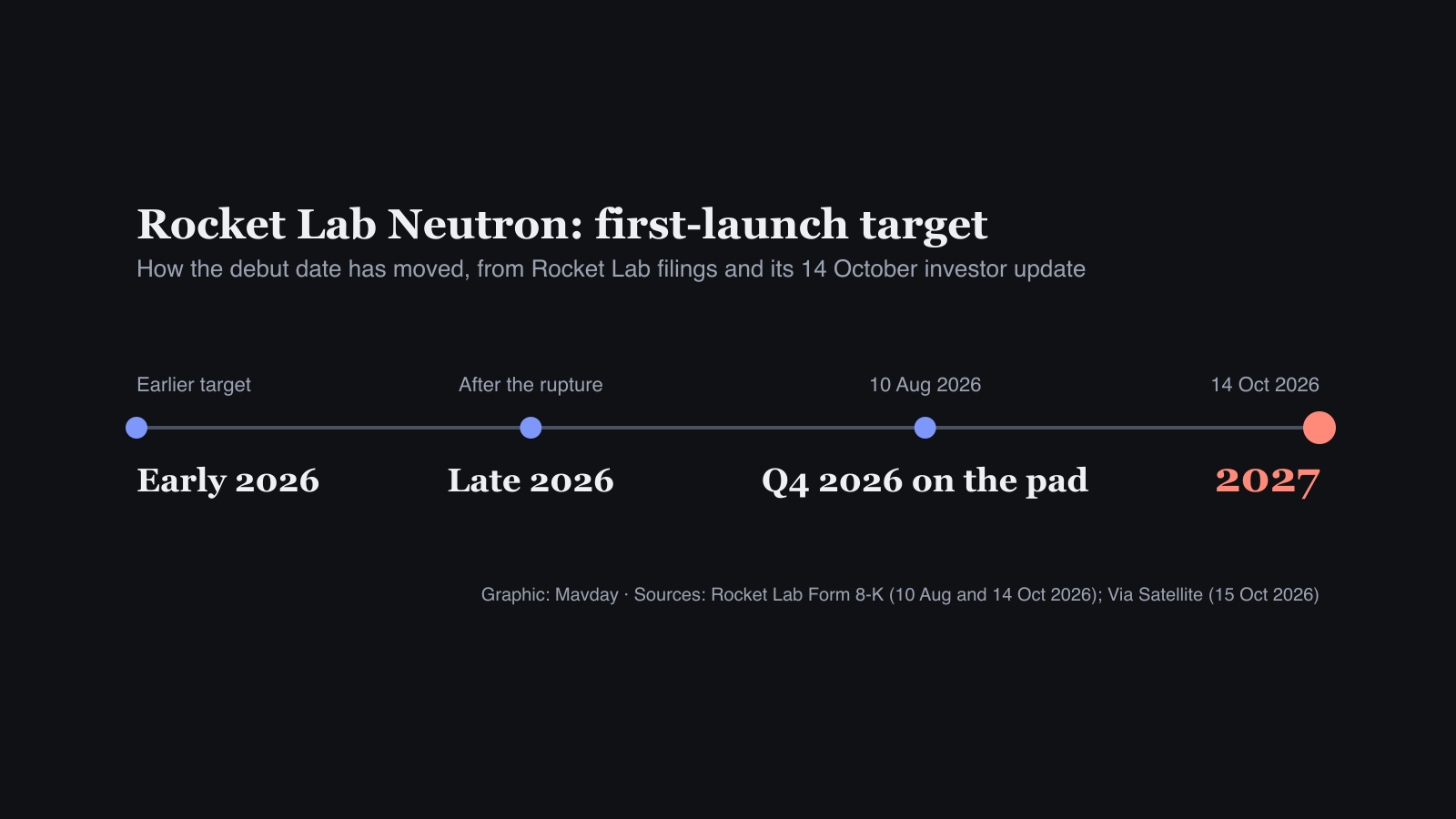
Rocket Lab has pushed the first launch of Neutron, its new reusable medium-lift rocket, into 2027. The company announced the delay after the US market closed on 14 October, in a filing with the SEC that said Neutron’s inaugural launch “is now expected to occur in 2027”. It didn’t give a month.
The delay matters beyond the launch schedule. Neutron is the rocket Rocket Lab needs to compete for larger satellites and constellation launches, and some of its biggest new contracts depend on it. Only two months earlier, on 10 August, the company said production of Neutron’s first-stage tank was “aligned with the target delivery of Neutron to the launch pad in Q4 2026”.
What went wrong with Neutron
Chief executive Peter Beck explained the cause in an investor update on 14 October, as reported by Via Satellite:
- The original problem: in January, a Neutron tank ruptured during testing. Rocket Lab traced it to a manufacturing defect in a tank hand-laid by a contractor, and moved production to an automated fibre placement (AFP) machine.
- The new problem: the AFP-built propellant dome had air pockets between the layers of carbon fibre. Beck said Rocket Lab has since fixed the manufacturing process to make a new forward dome, but the time spent on the issue pushes the launch into 2027.
- What happens next: Rocket Lab will test the new dome to confirm there are no voids, assemble the forward and aft domes into the full first stage, then run hydrostatic and cryogenic test campaigns. Beck expects that work to run before and during the first quarter of 2027, when the company will set a new launch date.
“We’re balancing speed to first launch with bringing a reliable high cadence rocket to market for the long term, which means making deliberate choices about time lines to support reliability going long into the future,” Beck said, according to Via Satellite.
How the shares reacted
Rocket Lab shares were already falling in a broad sell-off in growth and tech stocks before the announcement, the same rout that hit AI cloud stocks such as IREN and chipmakers including TSMC. All prices are Nasdaq closes:
| Date | Close | Change |
|---|---|---|
| 13 Oct | $64.22 | |
| 14 Oct | $59.18 | −7.8% (before the after-hours announcement) |
| 15 Oct | $55.25 | −6.6% (first session after the delay) |
| 16 Oct | $50.84 | −8.0% |
That is a 20.8% fall over three sessions. Via Satellite reported that the stock fell more than 10% after the disclosure, before recovering some ground on 15 October.
Why Neutron matters to Rocket Lab’s business
Rocket Lab’s results for the second quarter, filed on 10 August, show how much now rests on the new rocket:
- Record revenue of $234m, up 62% year on year, and a record backlog of $2.36bn, up 137%.
- A $397m contract from the US Space Force’s SB-AMTI programme to build Flatellite spacecraft that are due to launch on Neutron.
- A launch backlog of more than 90 launches across Electron, HASTE and Neutron.
Its existing Electron rocket keeps flying, and none of those Electron contracts is affected. The question is timing: revenue tied to Neutron launches, and to satellites that need Neutron to fly, moves later with every slip.
Our take
Neutron FAQ
When is Rocket Lab Neutron’s first launch? Rocket Lab now expects Neutron’s first launch in 2027. It plans to set a specific date after test campaigns that run into the first quarter of 2027.
Why was Neutron delayed? Air pockets were found between carbon-fibre layers in the first-stage propellant dome built on Rocket Lab’s automated fibre placement machine. Rocket Lab says it has fixed the manufacturing process, but rebuilding and retesting the dome pushes the launch into next year.
Does the delay affect Electron launches? No. Electron, Rocket Lab’s small rocket, is a separate vehicle and continues to fly.
How did Rocket Lab stock react? The shares closed at $55.25 on Nasdaq on 15 October, down 6.6%, the first session after the announcement, having fallen 7.8% the day before amid a wider sell-off.