Markets Analysis

Why AI stocks fell: Big Tech's AI spending now outruns its cash

Alphabet had its worst day since 2004, and Amazon and Intel dragged futures lower before Friday's open. The filings show three of four big AI spenders paid out more cash than they made.

Alphabet, Amazon and Meta each spent more on data centres, chips and other equipment from July to September than their businesses brought in as cash. Alphabet borrowed $29.0bn and sold $12.4bn of new shares in the quarter, and bought back no stock, after $11.5bn of buybacks a year earlier.
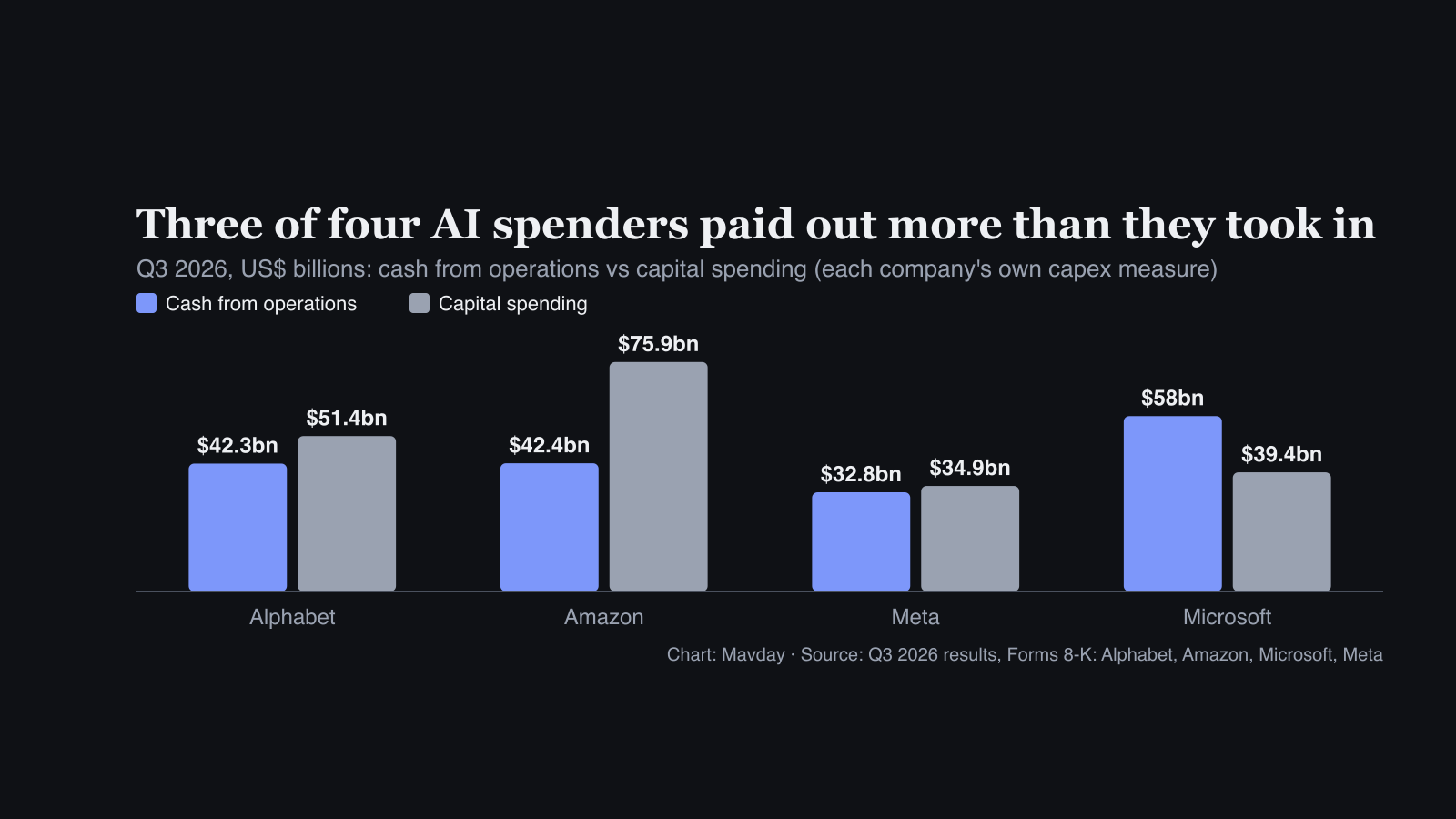
Grouped bar chart of Q3 2026 cash from operations against capital spending: Alphabet $42.3bn against $51.4bn, Amazon $42.4bn against $75.9bn, Meta $32.8bn against $34.9bn, and Microsoft $58bn against $39.4bn
Chart: Mavday. Source: Q3 2026 results, Forms 8-K: Alphabet, Amazon, Microsoft, Meta

On Thursday 29 October, Alphabet’s Class A shares fell 12.6% to $283.82, wiping out about $482bn of market value, Fortune reported. It was their worst day since they began trading in 2004. The Nasdaq 100 fell 1.4%, but the equal-weight S&P 500, where every company counts the same, rose 1.2%, Bloomberg reported: the selling was in the biggest names.

“At this point, the market isn’t just asking how fast you can grow. It’s asking what you have to spend to get there,” Jake Behan, head of capital markets at Direxion, told Reuters on 30 October.

Why tech stocks are down when revenue is booming

Sales are growing fast. In the third quarter:

  • Alphabet: revenue up 25%, and Google Cloud up 103% to $30.7bn.
  • Amazon: AWS sales up 39% to $46.0bn.
  • Microsoft: Azure revenue up 48%.
  • Meta: revenue up 26% to $64.6bn.

The problem is the bill, and the measure that shows it is free cash flow. That’s the cash a business brings in from operations, minus what it spends on long-lived assets such as data centres, servers and chips (capital spending, or capex). When it’s negative, the company pays for the build-out with money from somewhere else: savings, borrowing or selling shares.
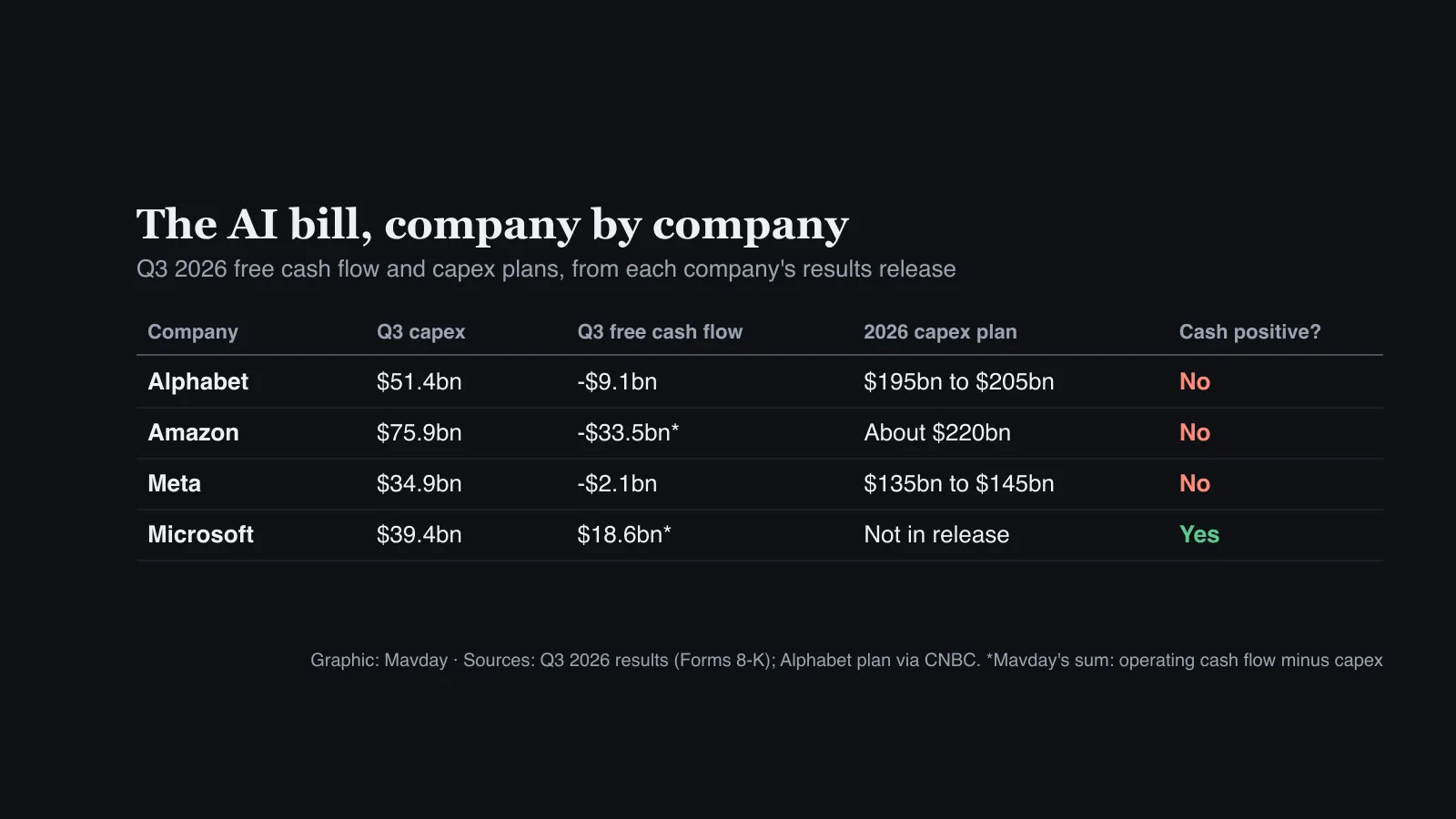
Table of four companies’ Q3 2026 capex, free cash flow and 2026 capex plans: Alphabet $51.4bn, -$9.1bn, $195bn to $205bn; Amazon $75.9bn, -$33.5bn, about $220bn; Meta $34.9bn, -$2.1bn, $135bn to $145bn; Microsoft $39.4bn, $18.6bn, not in release. Only Microsoft is marked cash positive

Figures marked * are our arithmetic: operating cash flow minus capex. Each company measures capex its own way. Alphabet's is purchases of property and equipment. Amazon's is net of proceeds from sales and incentives. Meta's includes principal payments on finance leases. Microsoft's excludes finance leases. Graphic: Mavday. Sources: Q3 2026 results, Forms 8-K; CNBC

Alphabet more than doubled its capex from a year earlier. Its free cash flow went from -$5.9bn in the second quarter to -$9.1bn in the third. It kept its 2026 capex plan of $195bn to $205bn, CNBC reported.

Amazon says its year-on-year increase in spending “primarily reflects investments in artificial intelligence.” It raised $48.1bn of long-term debt in the quarter.

Meta reported on 21 October that free cash flow “was negative $2.12 billion”. Its shares fell 7.0% the next day, Reuters reported.

Microsoft still makes more cash than it spends

Microsoft doubled its spending on property and equipment from a year earlier, to $39.4bn. But operations brought in $58.0bn, leaving about $18.6bn. Its shares fell just 0.2% on 29 October “even though the company reported surging cloud growth and kept capital expenditures in check,” Bloomberg reported.

Not every reason was about spending

Bank of America analyst Justin Post also pointed to a “slowdown in high-margin search growth” at Google, Fortune reported on 29 October. And over the past twelve months, Alphabet’s free cash flow was still positive, at $19.7bn.

Friday: Amazon and Intel pull futures lower

At 04:04 ET (08:04 UK time) on Friday, Nasdaq 100 futures were down 2.16%, Reuters reported. Amazon was down 7.2% and Intel 25% in premarket trading, moves that may change by the US open at 13:30 UK time.

Intel’s fall is a separate story, about PCs. It forecast fourth-quarter revenue of $15.0bn to $16.0bn, below the $16.5bn it made in the third.

A glowing stack of abstract blocks rises from a dark base, fed by a thin, fading river of light

Abstract illustration of spending outpacing incoming cash. Conceptual artwork, not a picture of any real company or product. Illustration: Mavday, AI-generated

Our take

Get the builder’s briefing

Twice a week: the AI news worth knowing, from new models and agents to the money behind them. No hype, no spam.

We’ll email you to confirm before the first issue. Unsubscribe any time. See our privacy policy.

Sources

10
  1. Alphabet announces third quarter 2026 results (Form 8-K exhibit 99.1) · Alphabet, SEC EDGAR, 28 Oct 2026
  2. Amazon.com announces third quarter results (Form 8-K exhibit 99.1) · Amazon, SEC EDGAR, 29 Oct 2026
  3. Microsoft first quarter fiscal year 2027 results (Form 8-K exhibit 99.1) · Microsoft, SEC EDGAR, 28 Oct 2026
  4. Meta reports third quarter 2026 results (Form 8-K exhibit 99.1) · Meta, SEC EDGAR, 21 Oct 2026
  5. Intel reports third-quarter 2026 financial results (Form 8-K exhibit 99.1) · Intel, SEC EDGAR, 29 Oct 2026
  6. Alphabet just had its worst day as a public company. BofA now values Google search at a lower multiple than fossil fuel stocks · Fortune, 29 Oct 2026
  7. Tech stocks slide as Alphabet's record plunge revives AI fears · Bloomberg via The National, 29 Oct 2026
  8. Nasdaq futures tumble as Amazon, Intel results deepen AI spending woes · Reuters via Investing.com, 30 Oct 2026
  9. S&P 500, Nasdaq end sharply lower as revived AI doubts ignite tech selloff · Reuters via Yahoo Finance, 22 Oct 2026
  10. Alphabet sinks 10% as it holds 2026 capex unchanged, expects significant increase in 2027 · CNBC, 28 Oct 2026

Mr B

Co-founder & AI Engineer

Mr B is a co-founder of Mavday and an AI engineer, closely involved in agentic engineering: building software with AI agents. He writes about how that works in practice, and about the wider AI industry.

Work with us on a tutorial for your product

More in Markets

See all

Latest