avday
Anthropic made an operating profit of $974m in the April to June quarter. Yet its first half ended with a net loss of $80.7bn.
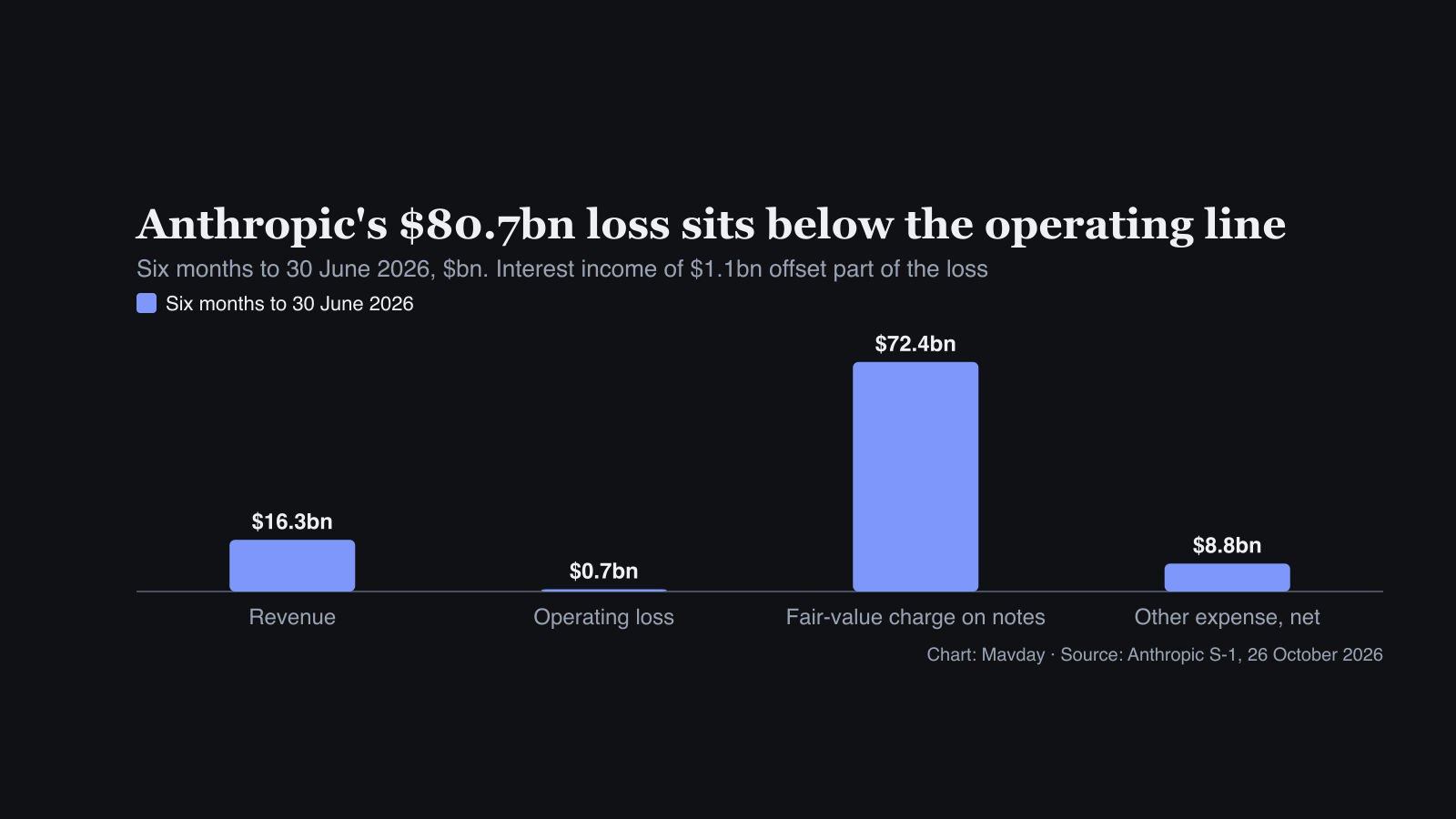
The Anthropic S-1, filed on 26 October, explains the gap: a $72.4bn charge, mainly because notes Amazon holds rose in value as Anthropic’s valuation climbed. Every note still outstanding on 30 June belonged to Amazon. Across the half, the operating loss was just $693m.
The bigger story is a loop. Amazon and Google:
- invest in Anthropic, and Amazon books gains as its value rises;
- collect fees when Claude sells through their clouds;
- get compute contracts back, worth at least $224.5bn between them.
The filing proposes the Nasdaq ticker ANT. It leaves the price range, share count and amount raised blank, along with revenue for the September quarter.
Anthropic S-1 revenue: up 1,300% in a year
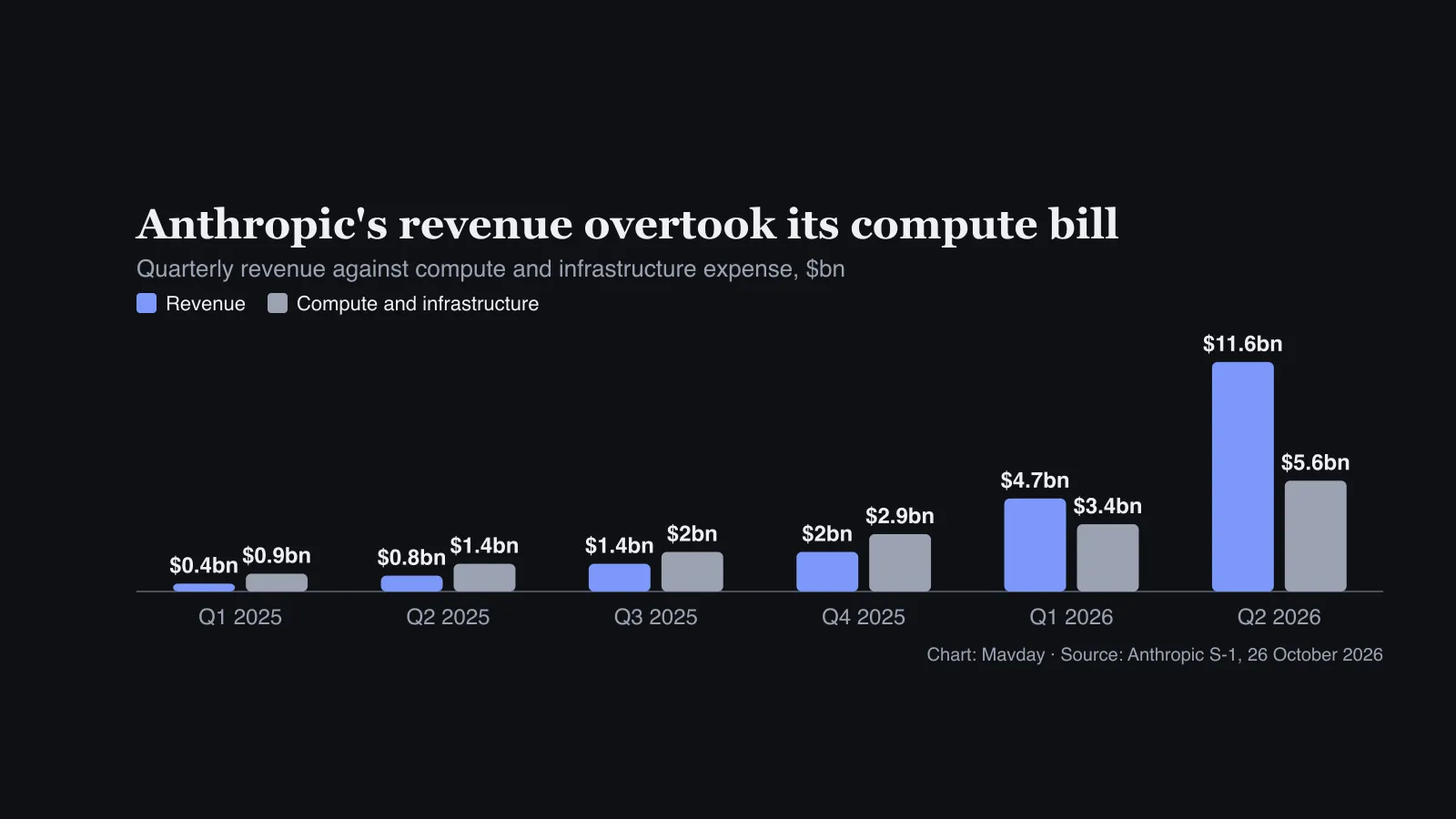
Revenue was $41m in 2023, $386m in 2024 and $4.6bn in 2025. In the first half of 2026 it reached $16.3bn, up 1,300%. The June quarter alone brought in $11.6bn.
Compute is the biggest cost, but revenue now outruns it. Compute and infrastructure expense was 251% of revenue in the March 2025 quarter and 48% in the June 2026 quarter.
More than 11,900 customers paid $100,000 or more over the twelve months to 30 September, up from more than 950 a year earlier. Net revenue retention was about 900%. By the filing’s definition, paying customers from a year earlier, excluding Pro and Max subscribers, spent roughly nine times as much in the latest quarter.
One number is awkward. About 5% to 7% of revenue in the nine months to 30 September came from customers later found breaking Anthropic’s usage policy or commercial terms. It expects that share to fall after tightening enforcement in August and September.
One unnamed customer supplied 11% of first-half revenue, though none passed 10% over the nine months to 30 September.
The $80.7bn loss is mostly a mark-up on Amazon’s notes
On 30 June, Amazon held $6.2bn of notes it can turn into Anthropic shares at $2.09 and $5.05 each, or the IPO price if lower. Series H investors in May and June paid the equivalent of $58.90 a share, by our arithmetic.
The richer Anthropic gets, the more those notes are worth, and Anthropic books the rise as a loss. Its balance sheet carried the notes at $108.6bn on 30 June, against $6.2bn of principal.
The biggest quarterly charge, $59.6bn, came in the June quarter, which the filing ties to the valuation rise in the Series H round. That’s the quarter Amazon booked $53.4bn of other income, primarily from its Anthropic investments. As we read it, both reflect the same rise in Anthropic’s valuation.
A further $8.8bn of other expense came mainly from fair-value accounting on newer note purchase agreements. Both are mark-to-market entries, and no cash changes hands. Strip them out, along with stock-based pay and donation-matching charges, and Anthropic’s own adjusted measure shows net income of $2.7bn for the half.
Cash tells a calmer story. Operating cash flow was $3.9bn in the first half, against an outflow of $1.5bn a year earlier. Anthropic held $112.4bn of cash and $19.3bn of short-term investments on 30 June.
Where the money goes: its backers, and two surprises
The filing lists the compute deals one by one. Anthropic must spend at least $110.0bn with Amazon from May 2026 to April 2036, and about $114.5bn with Google from April 2026 to July 2033. If it spends less, it pays the difference.
There may be more for Google. Anthropic estimates a further $125bn to $150bn for extra TPU compute from 2028 to 2031, from providers including Google, outside its commitments table. Microsoft, also an investor, has a commitment of at least $44.9bn.
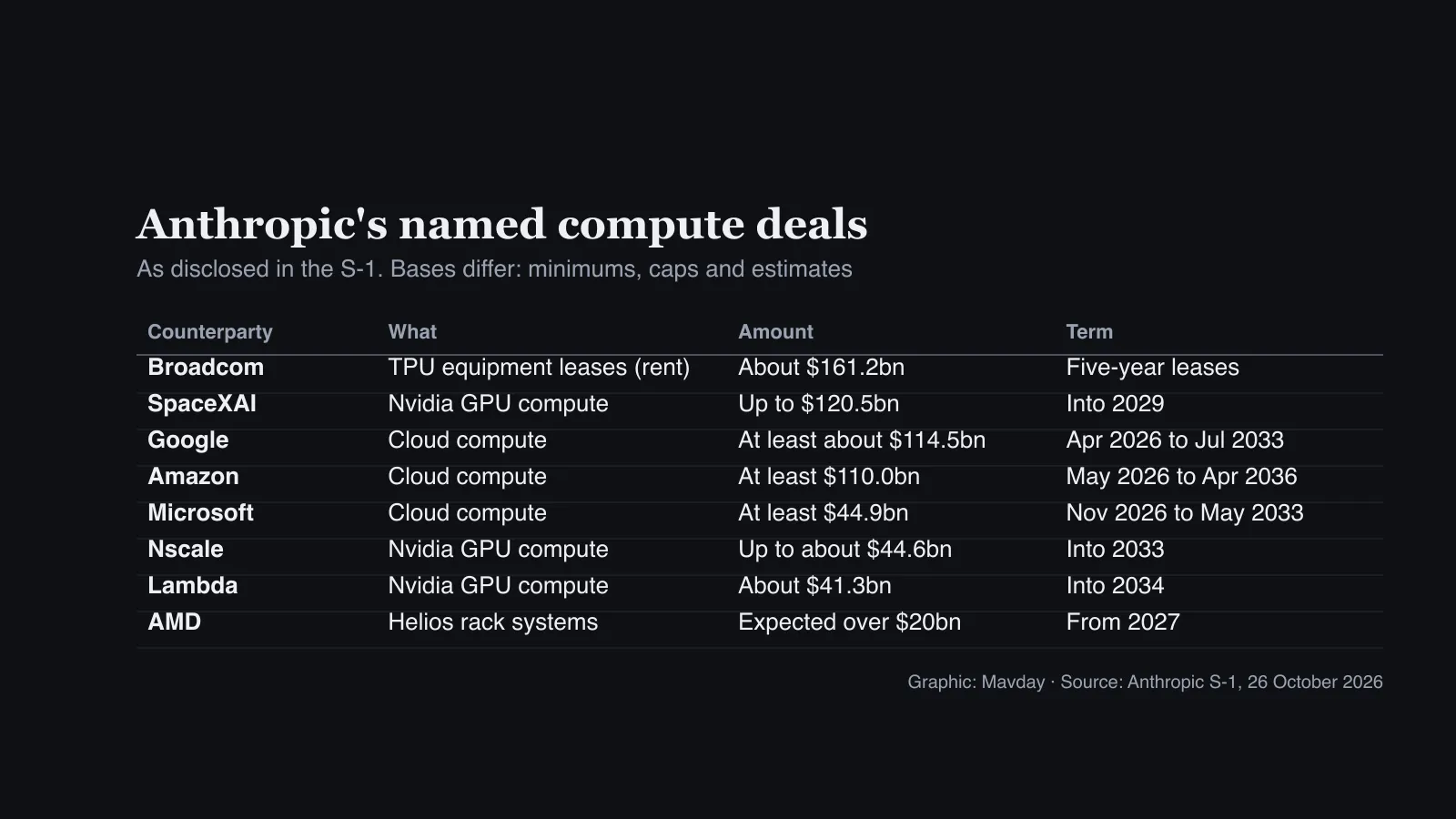
The two largest figures in the table aren’t with Amazon or Google, though they’re measured differently. Rent on Broadcom’s TPU equipment leases totals about $161.2bn. And Anthropic agreed to spend up to $120.5bn on Nvidia-powered compute from SpaceXAI, the SpaceX subsidiary formerly called X.AI. That’s about $3.1bn a month once all its capacity is delivered.
Unlike the cloud minimums, either side can cancel the SpaceXAI deals on 90 days’ notice once their first terms end in early 2027.
The clouds also sit in the sales channel. About 48% of first-half revenue came through cloud marketplaces. Anthropic pays a fee to each cloud that sells Claude, and fees to channel partners rose by $2.7bn in the first half. Google Cloud is now adding OpenAI’s models too, in private preview so far.
And they supply cash. Google put $10bn and Amazon $5bn into the Series H round. Undrawn note facilities total $77bn, subject to conditions:
- Google: $20bn. It can also buy up to $10bn of stock at the IPO price, shrinking its facility by as much.
- Amazon: $15bn.
- Broadcom: $42bn, which only funds rent on its own leases.
Who controls Anthropic after the IPO
Public buyers get one vote a share. Control sits elsewhere:
- Class F: a single share, held by a company whose members are the seven co-founders, carries 50.1% of the votes.
- Class T: the Long-Term Benefit Trust’s single share can generally elect a majority of the board.
- Class N: non-voting shares.
Amazon and Google, the backers with the most money in the loop, will hold those Class N shares, each above 5%. The filing leaves their exact stakes blank. Amazon’s notes can’t convert beyond a 12% ownership cap unless it waives it. Anthropic has also given 5% of its fully diluted shares to its own public benefit fund.
The IPO money goes to general corporate purposes, including compute, and to tax bills from staff share awards.

Our take: the Anthropic IPO’s risk is the loop, not the loss
Our view, from the filing’s numbers: the operating business is real. A $974m operating profit in one quarter and $3.9bn of operating cash in six months aren’t paper.
The risk is the fixed bills. The Amazon and Google minimums alone total $224.5bn. At the June quarter’s pace, that’s nearly five years of revenue, by our arithmetic. Anthropic itself warns that margins may shrink as new compute arrives before the revenue it supports.
The legal bill is real money too. Anthropic settled the Bartz authors’ copyright case for $1.5bn, approved in July 2026, and suits from music publishers and Reddit are pending.
We’d turn more cautious if the blank September quarter shows revenue stalling near $11.6bn while those payments ramp up.
What to watch next
Bloomberg’s Ed Ludlow reported the filing plan on the morning of 26 October, and Bloomberg says formal marketing could start as soon as the week of 9 November. The price range should arrive in an amended filing. Reuters reported on 20 October, citing unnamed sources, that OpenAI wants to raise before Anthropic lists.
Alphabet and Microsoft report on 28 October, and Amazon on 29 October. Check their other income lines for Anthropic gains. Amazon’s was $53.4bn last quarter.